How to Select a Window Installation Service for Your Home

To select a window installation service, verify the company's licensing, insurance, and manufacturer certifications, then collect at least three written bids that break out labor, materials, and warranty terms separately. Confirm who physically performs the installation, because a crew employed by the company and trained on the product is accountable in a way a chain of subcontractors is not. Read both warranties before signing, the product warranty on the window and the separate workmanship warranty on the labor, and check that the contractor pulls the permit and hands over the documentation at the end. Below we walk through each verification step, the full criteria list, the questions worth asking every company you interview, and what the project looks like once you have chosen.
Key Takeaways
- Verify the license yourself through the state licensing lookup rather than accepting a number on a brochure, and ask for current certificates of general liability and workers' compensation insurance.
- Collect at least three written bids that separate labor from materials, and compare them line by line rather than on the bottom-line total.
- Ask who physically installs the windows, since in-house crews trained on one product line answer to the company that sold you the job.
- Product warranties commonly run 10 to 20 years or a limited lifetime, while workmanship warranties on the labor typically run 1 to 5 years. They are two different documents.
- In this market, confirm the product carries a valid Florida Product Approval or Miami-Dade Notice of Acceptance for your wind zone before anything is ordered.
- The contractor should pull the permit, meet the inspector, and hand over documentation that supports your wind mitigation insurance credit.
- Take your time: 68 percent of homeowners spent one to four weeks researching before choosing, and most compared two or three quotes, according to This Old House's 2026 survey of 1,000 homeowners.
How Do You Select a Window Installation Service?
You select a window installation service by verifying credentials, confirming who does the physical work, collecting three itemized written bids, reading both warranty documents, and checking reviews the company did not curate. Five steps, in that order, and the order matters because each one narrows the field for the next.
Run them in sequence:
- Verify license and insurance. Look the license up yourself and request current certificates of general liability and workers' compensation coverage.
- Confirm who installs. Ask whether the crew is employed by the company, certified by the manufacturer, or subcontracted, and who supervises on site.
- Collect three written bids. Each should name the product, the installation method, and every line item, with labor and materials separated.
- Read both warranties. The product warranty and the workmanship warranty are separate documents with separate terms and separate signatories.
- Check unfiltered reviews. Read the middle and negative reviews and how the company responded, rather than the overall rating.
Homeowners who follow something like this report better outcomes. In the This Old House 2026 survey of 1,000 recent window customers, 68 percent spent one to four weeks researching companies, 44 percent compared two quotes and 34 percent compared three, and 94 percent ended up satisfied with the result. Satisfaction at that level follows preparation rather than luck.
How Do You Verify a Contractor's License and Insurance?
You verify a contractor's license and insurance by looking the license number up in the state licensing database and requesting current certificates of insurance issued directly by the carrier. A number printed on a flyer verifies nothing by itself.
The lookup takes about two minutes and returns more than a yes or no. It shows the license class, which defines what the contractor is legally allowed to build, the current status, the expiration date, and any disciplinary history attached to the license. Disciplinary history is the item no brochure will ever contain, which is exactly why the public record is worth the two minutes.
Insurance splits into two coverages that protect different things. General liability covers damage to your home during the work, and workers' compensation covers injury to the crew on your property, which matters because an uninsured injury on an uninsured job can land on the homeowner. Homeowner exposure of that kind is avoidable by asking for both certificates, and an established company produces them without friction because it gets asked constantly.
What Certifications Should a Window Installer Have?
A window installer should have manufacturer certification on the specific product line they install, and ideally a recognized industry installation credential such as InstallationMasters or membership in the American Window and Door Institute. Certification means someone trained and tested them against a documented standard.
Manufacturer certification carries practical weight beyond the credential. Many product warranties assume installation to the manufacturer's documented method, so a crew trained on that method protects the coverage you are paying for. Coverage that depends on method is one more reason to ask who trained the people who will be in your house.
Should a Window Company Use In-House Crews or Subcontractors?
In-house crews are better than subcontractors for window installation, because one company stays accountable for the product, the labor, and anything that needs correcting afterward. Subcontracted work is not automatically bad, and plenty of good installers work that way, but it adds a seam that problems can fall into.
Accountability is the practical difference. When the manufacturer, the seller, and the installing crew are three unrelated businesses, a leak at the perimeter can bounce between them while nobody writes the check. A single company that sold the job and employs the crew has no one to hand the problem to. We run in-house crews for exactly that reason, and most of the installation mistakes that produce callbacks come from unfamiliarity with a specific product rather than from carelessness.
Ask the question plainly at the estimate: who installs these, are they employees, how were they trained on this product, and who supervises on site. Supervision on site is the follow-up question most people forget, and the answer tells you whether anyone is checking the work before the crew drives away.
What Should a Window Installation Quote Include?
A window installation quote should include every opening, the exact product and performance rating for each, the installation method, labor separated from materials, removal and disposal, permit and inspection fees, finish repair, the payment schedule, and both warranty terms. Anything promised verbally and left off the document does not exist.
Work down this list on every bid you collect:
- An opening-by-opening schedule with sizes, styles, and glass package named for each.
- The product line and the approval number for the wind zone, not just a brand.
- Whether the work is insert or full-frame replacement, stated plainly.
- Labor and materials shown as separate figures rather than one combined number.
- Removal and haul-away of the old units, including the dump fee.
- Permit fees, inspection coordination, and any engineering the jurisdiction requires.
- Interior casing and exterior trim or stucco repair after installation.
- Product warranty terms and workmanship warranty terms, with lengths stated.
- Deposit amount, milestone payments, and the final payment trigger.
Separated line items are what make three bids comparable. A lower total attached to a smaller scope is not a better price, and about 1 in 4 homeowners in the 2026 survey paid more than their original quote, usually because an omitted item resurfaced mid-project. Our breakdown of window installation costs shows which items go missing from thin estimates most often.
How Many Quotes Should You Get for Window Replacement?
You should get three quotes for window replacement, which is both the industry recommendation and roughly what homeowners actually do. The 2026 survey found 44 percent compared two and 34 percent compared three before deciding.
Three is enough to reveal the shape of the market without stalling the project. Two quotes tell you which is cheaper and nothing else, while three show you where the middle sits and make an outlier obvious in either direction. Outliers on the low side almost always turn out to be scope gaps rather than efficiency.
What to Look for in a Window Installation Service
What you look for in a window installation service is a verifiable license, current insurance, manufacturer certification, in-house or certified crews, an itemized written scope, two clearly stated warranties, permit handling, local permanence, and a service department that answers after the sale. Nine criteria, each with a question that produces a checkable answer.
The last row separates companies more sharply than any other, and almost nobody asks it. At estimate time you are thinking about getting windows, not about needing a replacement sash in year six, and a company that keeps your order records can build the part while a reseller has to chase a factory that may have discontinued the line.
What Is the Difference Between a Product Warranty and a Workmanship Warranty?
The difference between a product warranty and a workmanship warranty is that the product warranty comes from the manufacturer and covers the window itself, while the workmanship warranty comes from the installer and covers the labor. Two documents, two signatories, two different lengths, and a leak at the perimeter falls under the second one.
Read five things in any warranty before you sign: which components are covered, whether labor is included or only parts, whose lifetime the word lifetime refers to, whether coverage transfers to the next owner, and what the exclusions section says. The exclusions section is the one people skip and the one that decides claims. We publish our workmanship warranty terms so they can be read before a contract rather than after one.
Is a Window Warranty Transferable?
Some window warranties are transferable and many are not, so check the transfer clause specifically rather than assuming a lifetime warranty travels with the house. Transferability is worth real money at resale.
A transferable warranty also signals something about the company issuing it. Transferring coverage to a stranger years from now only makes sense for a business that expects to still be operating then, which is a quiet form of confidence worth noticing.
Who Pulls the Permit for Window Replacement?
The contractor pulls the permit for window replacement, and the fee should appear as a line item on your estimate rather than as a surprise later. Florida requires a permit for window replacement, and the inspection that follows is what verifies the work against the approved method.
Permit handling tells you a great deal about a company. Pulling a permit requires an active license, puts the work on public record, and brings an inspector who checks product labeling, fastener patterns, and installation method. Method verification by a third party is precisely what an operator working off the books is avoiding, which is why "we can skip the permit and save you money" is the costliest sentence in this trade.
Unpermitted work follows the house. It surfaces at resale, complicates insurance questions, and can leave you unable to document opening protection when it matters. Every impact windows and doors project we run is permitted and inspected, because the documentation is half the value of the work.
How Do You Confirm a Window Is Approved for Your Wind Zone?
You confirm a window is approved for your wind zone by asking for the Florida Product Approval number or the Miami-Dade Notice of Acceptance number for the exact product and looking it up in the public record. Florida Statute 553.842 establishes the statewide approval system those records come from.
Zone determines which record applies. Products installed in the High Velocity Hurricane Zone, which covers Miami-Dade and Broward counties, require a Miami-Dade NOA documenting testing to stricter impact and pressure standards. Standards differ enough between zones that two visually identical windows can carry different ratings, and only the approval number tells them apart.
Will the Contractor Provide Wind Mitigation Documentation?
A good contractor will provide wind mitigation documentation, and you should ask for it in writing before signing, because the paperwork is what converts the installation into an insurance discount. Florida Statute 627.0629 requires insurers to discount the windstorm portion of the premium for documented mitigation features, with credits running 10 to 45 percent depending on the combination documented.
The credit depends on evidence rather than on the windows themselves. A licensed inspector completes the mitigation form after the work, referencing the approved products and the permit record, and the carrier applies the discount at renewal. Renewal credits continue for the life of the products, which makes the closeout paperwork one of the highest-value items in the entire project.
How Do You Avoid Storm-Chasing Contractors?
You avoid storm-chasing contractors by confirming local permanence, verifying the license history, refusing to decide under time pressure, and declining to sign anything that transfers your rights. Operations that appear after a weather event sell hard and leave before the warranty matters.
Permanence is checkable in minutes. Look for a physical address you can drive to, a showroom, years of operation under the same name in your area, and a license with local history rather than a recent registration. We have run showrooms in Doral, Kendall, West Palm Beach, and Fort Myers for years. The counties we cover are listed on our service areas page.
Longevity is the other signal, and it is public information. A company that has operated under one name through multiple storm seasons has a track record that can be checked, which you can see on our about us page along with the license we have held since 2006.
Should You Sign Over Your Insurance Claim Rights to a Contractor?
No, you should not sign over your insurance claim rights to a contractor. An assignment of benefits transfers your rights under the policy to a third party, which hands that party control of your claim and limits what you can decide yourself. Keep the claim in your own name.
The offer usually arrives framed as convenience: let us handle everything with your insurer. Handling everything also means negotiating a settlement you no longer control and being bound by what the assignee agrees to. Read anything you are asked to sign in full, and be cautious with any document presented alongside a deadline.
How Much Deposit Should a Window Contractor Ask For?
A window contractor should ask for a deposit that reflects the custom order rather than the whole job, with the balance tied to delivery, installation, and completion milestones. Custom windows are built to your openings, so a meaningful deposit is normal and a demand for most of the total up front is not.
Structure matters more than the percentage. Payments tied to visible milestones, order placed, materials delivered, installation complete, inspection passed, keep both sides moving in the same direction. Direction of that kind disappears when a job is paid in full before anything arrives on site.
What Questions Should You Ask a Window Installer?
You should ask a window installer who manufactures the product, who installs it, what both warranties cover, how the license and insurance check out, what the approval number is, who pulls the permit, what the written scope includes, who to call in year three, and how long the quote is valid. Ask every company the same questions, and the answers sort the field quickly.
- Who manufactures these windows, and who is between the plant and my wall?
- Are the installers your employees, and how were they trained on this product?
- What is your license number, and may I have current insurance certificates?
- What is the product approval or NOA number for the units you are quoting?
- Who pulls the permit, and is the fee included in this estimate?
- May I read the product warranty and the workmanship warranty today?
- What is included in installation, and what is billed separately?
- Who do I call if something needs service in year three, and is there a visit charge?
- How long does this quote stand without changing?
That last question is quietly diagnostic. A quote that holds for a reasonable period belongs to a company confident in its pricing, while pressure to sign today is the loudest warning signal in this industry. Our guidance on choosing the right team covers what the answers should sound like in practice.
What Are the Two Main Types of Window Installation?
The two main types of window installation are insert replacement, where the new unit fits inside the existing frame, and full-frame replacement, where the opening is taken back to the structure and rebuilt. New construction installation with a nail fin is a third case that applies to new builds and additions rather than to replacements.
Insert work is faster and less invasive because the existing frame, trim, and casing stay in place, at the cost of a small amount of glass area. Full-frame work exposes the rough opening, which allows the framing to be inspected, the flashing to be installed properly, and the unit to be anchored directly to structure. Direct-to-structure anchoring is what engineered wind load ratings depend on, which is why impact window installation here is almost always full-frame.
Which Type of Window Installation Do I Want?
You want full-frame replacement if the existing frames are damaged, if the opening is masonry, or if the product must carry an engineered wind rating, and insert replacement if the existing frames are sound and no rating depends on the attachment. The contractor should state which method the quote covers.
Condition decides it more often than preference. Rot, out-of-square openings, failed sills, or any sign of past water entry all point to full-frame, since installing a new unit into a compromised frame locks the problem in behind a new window.
What to Expect During Installation
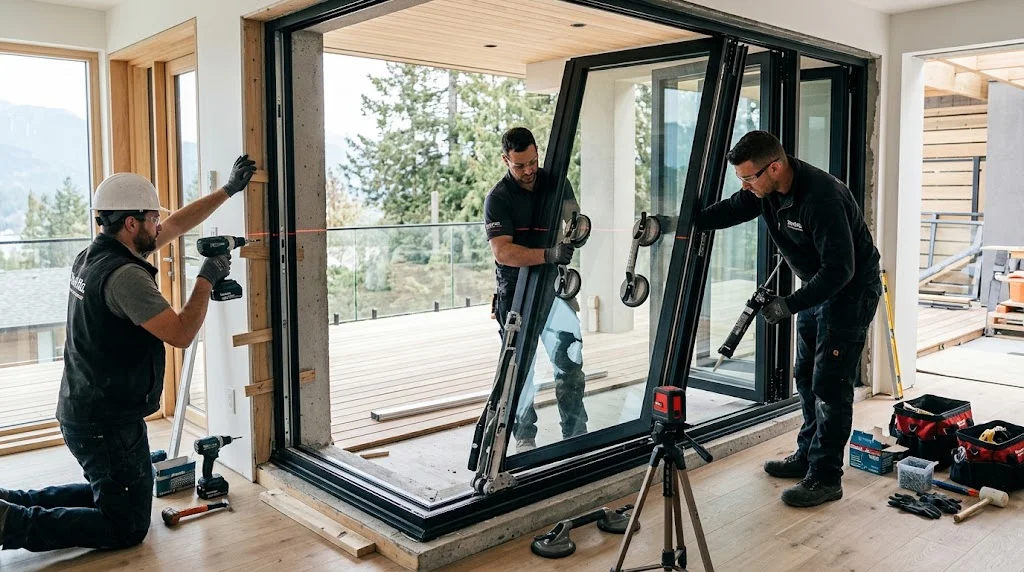
During installation, expect a crew working one elevation at a time, interior access at each opening, dust and debris contained to the work area, and most projects finishing in two to three days. Nearly a third of homeowners in the 2026 survey finished in a day or less, with larger or custom projects running longer. Our full walkthrough of the process step by step covers each stage in order.
How to Prepare for New Window Installation?
To prepare for new window installation, clear furniture, blinds, curtains, and wall decor at least three to four feet back from every opening, remove fragile items from nearby shelves, and clear plants and furniture from the exterior beneath each window. Access is what keeps the crew moving.
A few extra items save time on the day. Secure pets away from the work area, notify your alarm company if any windows carry sensors, and plan parking so the crew can stage materials near the house. Material staging close to the openings reduces how much traffic moves through your rooms.
Do Window Installers Need to Come Inside?
Yes, window installers need to come inside, because windows are removed, set, shimmed, sealed, and finished from the interior as well as the exterior. Someone over 18 should be home for the duration.
Interior work is also where the finish quality shows. Casing, sealant lines, and the interior stops are what you look at every day, so the crew spends real time inside each opening after the unit is anchored.
Does Window Replacement Include Trim?
Window replacement includes trim only when the estimate says so, which is why trim and finish repair belong on the written scope. Insert replacements usually leave existing interior casing and exterior trim in place, while full-frame work disturbs both and has to restore them.
Exterior finish is the bigger variable on masonry openings. Stucco cut back to reach the structure has to be patched and finished after the unit is set, and that work follows a cure schedule, so confirm whether patching, texture matching, and painting are included or excluded.
How Messy Is New Window Installation?
New window installation is moderately messy and largely containable, producing dust from removal, old sealant and fastener debris, and packaging waste from the new units. Professional crews mask the work area, lay drop cloths, and clean each opening before moving to the next.
Masonry work generates more dust than wood framing because cutting stucco and drilling block throws fine particulate. Particulate control is worth asking about directly: vacuum attachments, plastic sheeting at doorways, and daily cleanup should be part of the answer rather than an upgrade.
How Long Does It Take a Professional to Install a New Window?
A professional takes 30 to 60 minutes per opening for a standard insert replacement and 1 to 2 hours for a full-frame impact installation, with a whole-home project of 10 to 15 openings running one to three days. Survey data matches that, with most homeowners reporting two to three days.
Lead time is the longer clock and the one people underestimate. Custom units are built to your measurements after the contract is signed, so the manufacturing window usually dwarfs the installation window, as our breakdown of the installation schedule explains.
What Is the Cheapest Time of Year to Replace Windows?
The cheapest time of year to replace windows is during the off-peak months when contractor demand drops, which in this region falls between late fall and early spring rather than during the run-up to hurricane season. Scheduling in the slower months improves crew availability and shortens lead times.
Timing affects more than price. Demand spikes ahead of storm season, which stretches manufacturing queues and pushes installation dates out, so a project started in the quiet months is finished and documented before anyone needs it. Documentation finished early also means the mitigation credit starts applying at the next renewal rather than the one after, and the available rebates and incentives are worth checking at the same time.
Scope timing matters as much as calendar timing. Bundling every opening into one project spreads mobilization, permitting, and project management across more units, which is why a whole-home window and door replacement costs less per opening than the same work done in stages.
Frequently Asked Questions
What Is the Average Labor Cost to Install a New Window?
Labor runs roughly $100 to $300 per window for a standard insert replacement and $300 to $600 or more per window for full-frame work, with hourly labor on routine jobs near $50 to $65 per hour. Installed pricing including the unit is higher. This Old House's 2026 survey of 1,000 homeowners reported an average of $7,183 per project at about $525 per window before installation.
Does the Contractor Need to Be Lead-Safe Certified?
Yes, if your home was built before 1978, the contractor should be certified under the EPA's lead-safe renovation rules for work that disturbs painted surfaces. Window sills and moldings in older homes are common lead-paint locations. Ask for the certification alongside the license and insurance certificates, since the requirement applies to the firm performing the work.
How Long Does a Whole-Home Window Project Take?
A whole-home window project takes one to three days of installation for 10 to 15 openings, preceded by several weeks of manufacturing lead time for custom units. Permitting adds time at the front and the final inspection adds time at the end. Ask for the full timeline in writing, from contract signing through inspection, rather than only the installation days.
Can You Change Contractors After Signing?
You can sometimes change contractors after signing, depending on the cancellation terms in your contract and on how far the custom order has progressed. Many home improvement contracts include a short cancellation period, and custom units ordered after that point are usually non-refundable. Read the cancellation clause before signing rather than after.
Do Window Companies Offer Free Estimates?
Yes, most window companies offer free in-home estimates that include measuring your openings, discussing product options, and providing a written quote. A useful estimate visit produces measurements, a product recommendation with its approval number, and a line-item document you can compare against others. Treat a visit that produces only a single total figure as incomplete.
The Bottom Line
Selecting a window installation service comes down to verification rather than persuasion. Look up the license yourself, get current insurance certificates, find out whether the people installing your windows work for the company selling them, collect three itemized bids, and read both warranty documents before anything is signed. Five checks, and they take an afternoon.
In this state, add the local layer: a product approval number you can look up for your wind zone, a permit pulled by the contractor, an inspection that verifies the work, and closeout documentation that supports your wind mitigation credit. Those four items separate a window project that holds its value from one that creates questions at the next renewal or the next sale.
We have installed impact windows and doors across South Florida since 2006 with licensed, in-house crews, and we are glad to answer every question on the list above in writing. ASP SuperHome puts the approval numbers, the permit line, and the warranty terms on the estimate before you decide anything.
Reach out whenever you want to walk your openings together through our contact us page.
Meet With a Project Manager
Your first conversation is with a Project Manager who takes the time to understand your goals, walk you through your options, and stays connected throughout your project — from the initial consultation through the final walkthrough.


Insights & Resources
Stay informed with expert tips on roofing materials, hurricane codes, repairs, and South Florida construction standards.