How to Evaluate Window Installation Contractors


How to evaluate window installation contractors comes down to 7 checks, from the license and insurance to the written quote. Each check uses a public record or a document the contractor should hand over freely. Finishing every check before comparing price leaves only qualified companies on the list, which makes the final price comparison fair.
Key Takeaways
- Verify the contractor license on the Florida Department of Business and Professional Regulation website before anything else.
- Request a certificate of insurance that shows general liability and workers' compensation coverage.
- Confirm in writing that the contractor pulls the building permit and schedules each inspection.
- Compare itemized written quotes only after the references and installer answers hold up.
- Treat a large upfront payment, a phone-only price or a skipped permit as a red flag.
How to Evaluate Window Installation Contractors Step by Step
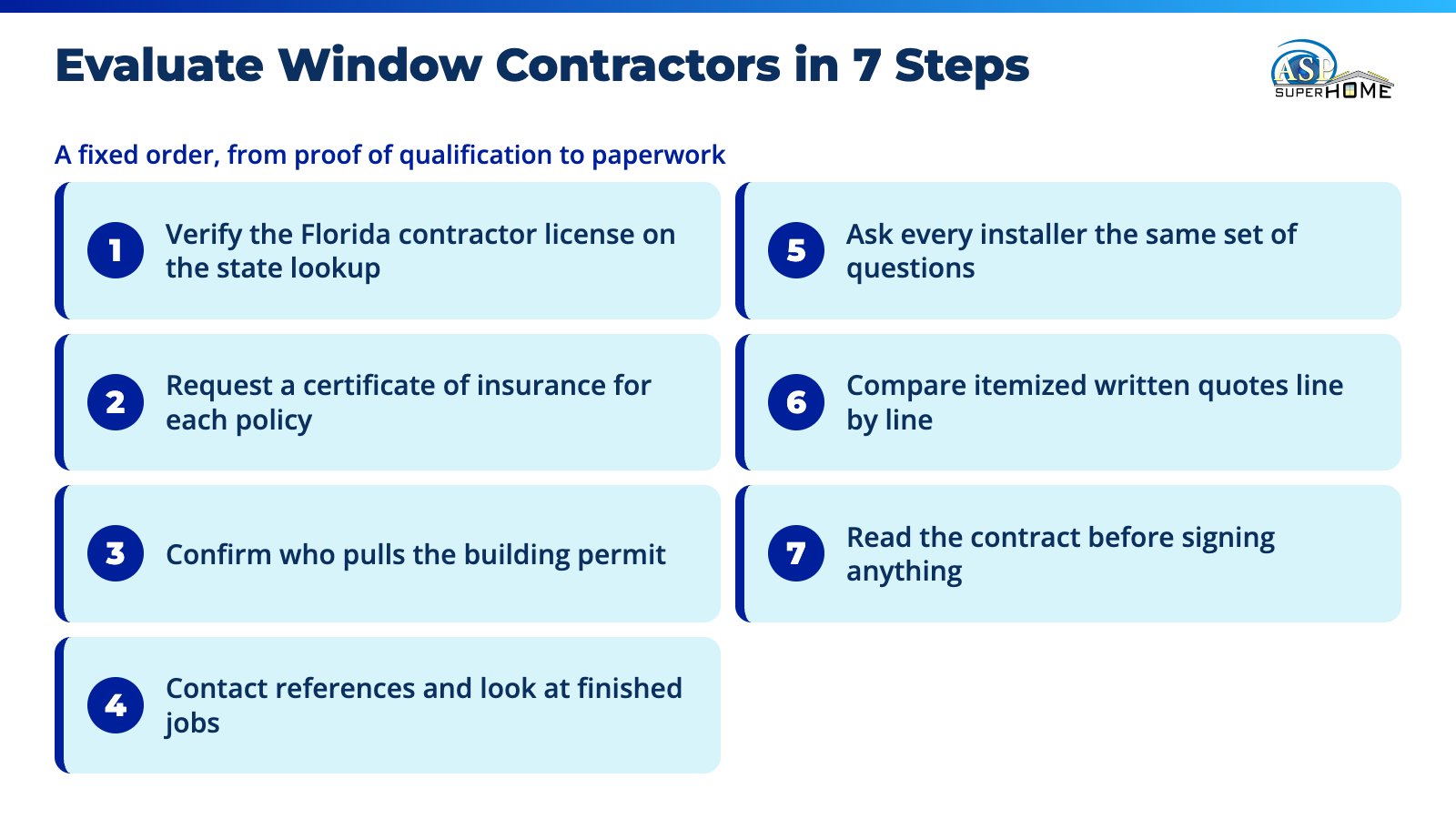
How to evaluate window installation contractors starts with a fixed order of 7 steps. Each step takes a short call, a document request or a few minutes online. The order moves from proof of qualification to proof of past work and then to paperwork.
- Verify the Florida contractor license on the state lookup.
- Request a certificate of insurance for each policy.
- Confirm who pulls the building permit.
- Contact references and look at finished jobs.
- Ask every installer the same set of questions.
- Compare itemized written quotes line by line.
- Read the contract before signing anything.
Those 7 steps apply to every company, whether the job covers 1 window or a whole house. Homeowners replacing storm protection should also confirm the company installs impact glass. Impact glass is laminated glass built to stay in its frame when struck. Each step gets its own section below, beginning with the license.
How Do You Verify a Florida Window Contractor License
You verify a Florida window contractor license by searching the Department of Business and Professional Regulation (DBPR) site. The DBPR keeps an online license lookup, searchable by company name or license number. The record shows whether the license is active and which license class the holder carries.
Florida issues certified licenses that apply statewide and registered licenses that apply only in the local areas where the holder registered. Either type should match the name on the quote and the contract. The license class should also cover window and door work, so ask which license applies to the job.
Match the license number printed on the quote to the lookup result. A number that fails the lookup, or a company that offers no number, ends the evaluation. Proof of a license leads straight to proof of insurance.
What Insurance Should a Window Installer Carry
A window installer should carry general liability insurance and workers' compensation insurance. General liability covers damage to your home or belongings during the work. Workers' compensation covers injuries to crew members on your property.
Ask the contractor to have the insurance company send a certificate of insurance directly to you. A certificate of insurance is a short document that lists each policy, its coverage limits and its expiration date. Check that the dates cover the full project.
Insurance protects the homeowner during the work, while the permit protects the home after it. Who pulls that permit is the next check.
Who Pulls the Permit for Window Installation
The contractor should pull the building permit for window installation, and the quote should say so in writing. Under the Florida Building Code, replacing windows and doors in Florida generally requires a building permit. The permit leads to inspections that confirm the work meets code.
Under the Florida Building Code, Miami-Dade and Broward counties form the High-Velocity Hurricane Zone (HVHZ). That zone sets stricter product and installation rules. Products there must carry a Florida Product Approval or a Miami-Dade Notice of Acceptance (NOA). Ask for the approval number of each product before signing.
A contractor who asks the homeowner to pull the permit shifts the paperwork and the responsibility onto the homeowner. A skipped permit also leaves no inspection record. Our list of installer mistakes shows how missing steps cause problems later. Permits and licenses prove qualification, but past customers prove performance.
How Do You Check References and Past Work
You check references and past work by asking for recent customers and contacting them directly. Request at least 3 references from jobs of similar size and finish. Ask each customer whether the crew arrived on time, protected the home and returned to fix any issues.
Photos and addresses of finished jobs add more evidence. Seeing completed work in person shows how the caulking, trim and interior finish hold up after several seasons. Online reviews also help, but a pattern across many reviews says more than one rating.
Our piece on choosing the right replacement team covers how reputation and crew structure fit together. References show how a contractor behaves after the payment clears. Direct questions to the contractor are the next check.
What Questions Should You Ask a Window Installer
The questions to ask a window installer cover the crew, the installation method, hidden damage, cleanup and service. Ask the same questions of every company so the answers compare directly. Write each answer down, then confirm it in the quote.
- Ask whether employees or subcontractors will install the windows.
- Ask whether each opening gets insert replacement or full-frame installation.
- Ask what happens if the crew finds rot or other hidden damage, and who approves the added cost.
- Ask whether the company holds the EPA lead-safe certification required for homes built before 1978.
- Ask who removes and hauls away the old windows and debris.
- Ask how long installation takes and how weather changes the schedule.
- Ask how to request service after the work is complete.
Insert replacement places a new window inside the existing frame. Full-frame installation removes the old window down to the rough opening, the framed hole in the wall. The Environmental Protection Agency (EPA) Renovation, Repair and Painting rule covers lead-safe work in older homes. Our article on picking a window installation service expands on these questions. Good answers carry weight only once they appear in writing, which brings the quote into focus.
What Should a Written Contract Include for Window Installation
A written contract for window installation should include the full scope of work, product details, permit responsibility, payment schedule and warranty terms. A verbal promise is hard to enforce on a job of this size. The contract and the itemized quote should match each other line by line.
An itemized quote lists each opening separately, which makes gaps visible before the work starts. Check that the contract contains these items:
- Company name, license number and contact information
- Number, size and style of every opening
- Product approval numbers and glass type for each window
- Installation method, removal of old windows and cleanup
- Permit and inspection responsibility
- Payment schedule, start date and estimated completion
- Manufacturer and workmanship warranty terms
A manufacturer warranty covers the product, while a workmanship warranty covers the installation. Payment terms deserve extra attention, because the deposit is the first payment written into the contract.
Should You Pay a Contractor 50% Upfront
No, you should not agree to a 50% upfront payment without a clear written reason and a payment schedule. Florida law sets rules once an initial payment passes 10 percent of the contract price for residential work. Under Florida Statute 489.126, the contractor must apply for permits within 30 days and start work within 90 days after permits issue.
The statute allows exceptions for just cause or a longer period the homeowner agrees to in writing. Payments tied to milestones, such as the product order, the installation and the passed final inspection, keep payment in step with progress. Keep every receipt and tie the final payment to the passed inspection.
A large demand for money before any permit is filed counts among the clearest warning signs. The full list of red flags follows.
What Are Red Flags When Hiring a Window Contractor
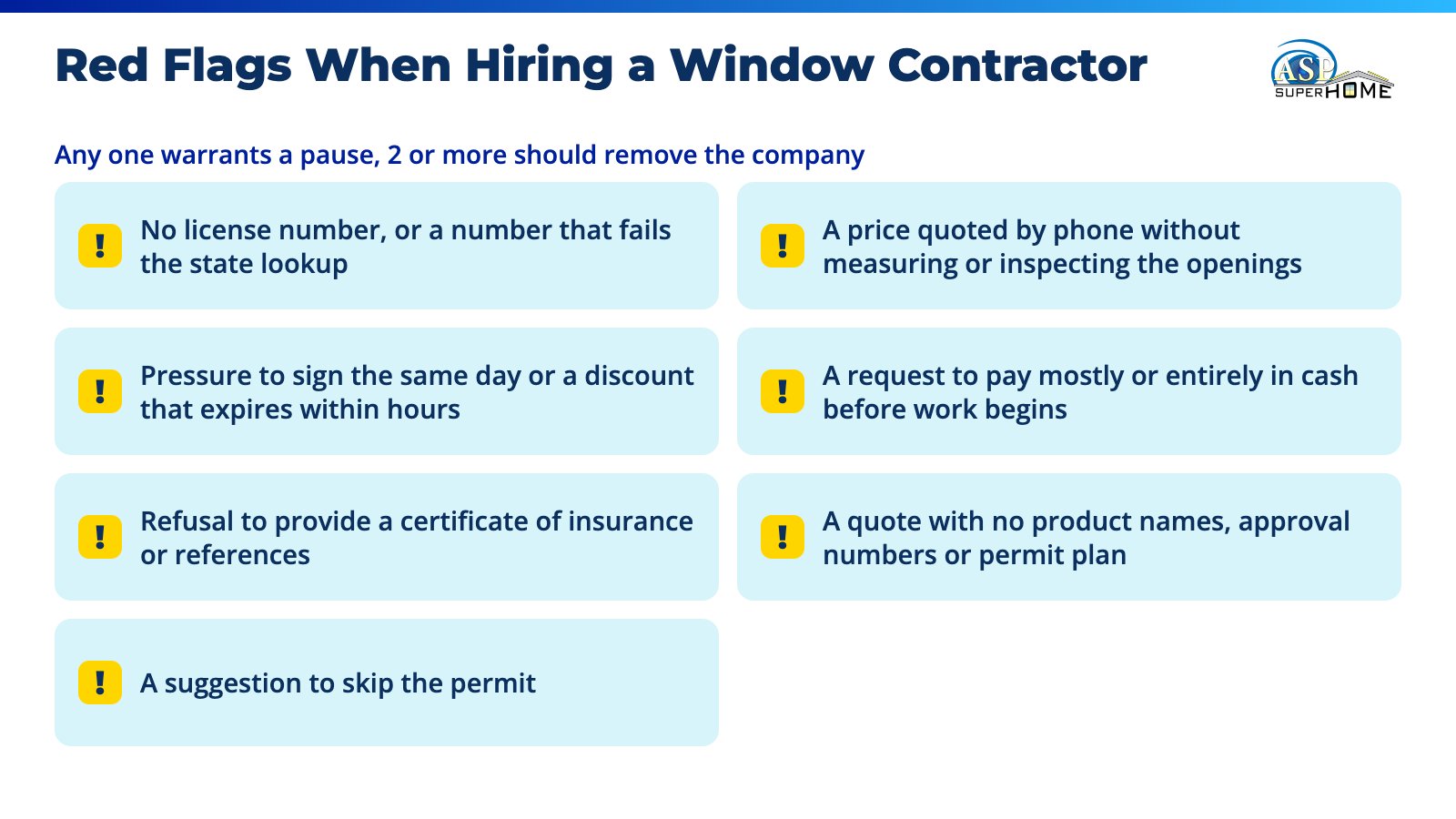
Red flags when hiring a window contractor include missing license numbers, price quotes without measuring and pressure to sign immediately. Each red flag points to a gap in either qualification or transparency. The same list shows how to spot a bad contractor before any money changes hands.
- No license number, or a number that fails the state lookup
- A price quoted by phone without measuring or inspecting the openings
- Pressure to sign the same day or a discount that expires within hours
- A request to pay mostly or entirely in cash before work begins
- Refusal to provide a certificate of insurance or references
- A quote with no product names, approval numbers or permit plan
- A suggestion to skip the permit
Any one of these signs warrants a pause, and 2 or more should remove the company from the list. Homeowners who feel pressed can take the quote home and compare it with the others. A contractor who passes every check still leaves one question, which is whether the finished work was done correctly.
How Do You Tell If Windows Were Installed Correctly
You tell if windows were installed correctly by checking operation, seals, trim and the final inspection record. Each window should open, close and lock smoothly without sticking. The frame should sit square in the opening with even gaps on every side.
Look for continuous sealant around the exterior frame and clean interior trim. Water stains, drafts or visible gaps after rain point to a sealing problem. A passed final inspection recorded under the permit confirms the work met code at that point.
Photos of any problem, taken soon after the work, support a service request under the workmanship warranty. The side questions below cover who to contact when a problem remains.
What Else Should You Know About Window Installation Contractors
Window installation contractors raise several side questions about license types, interior access, cleanup, tipping, pricing and complaints. The short answers below cover each one.
What Type of Contractor Installs Windows
A licensed construction contractor installs windows, and some companies focus only on windows and doors. Ask which license class applies and whether the company uses its own crews. Impact products follow the installation instructions in the product approval, so do-it-yourself installation carries added risk.
Do Window Installers Need to Come Inside
Yes, window installers usually need to come inside to remove old trim, check the opening and finish the interior seal. Clear a few feet around each window and take down blinds and curtains beforehand. The crew can then work without moving belongings.
How Messy Is New Window Installation
New window installation creates some dust and debris, mainly while the crew removes the old frames. Full-frame installation disturbs more material than insert replacement. Ask the contractor in writing who protects floors, hauls away debris and cleans up each day.
Am I Supposed to Tip My Window Installer
No, tipping a window installer is optional and never required. The contract price covers the labor. A thank-you or a cold drink on a hot day is a personal choice, not a contract term.
How Much Should a Contractor Charge to Install Windows
A contractor should charge a price that matches a written, itemized scope, because no single figure fits every home. Window size, style, glass package, installation method and the number of openings all change the total. Our guide to installation pricing explains each factor.
Who Do I Complain to About Badly Fitted Windows
Complaints about badly fitted windows go first to the contractor, in writing, with photos and the contract date. Licensed contractors answer to the DBPR, and permit or code concerns go to the local building department. Our limited warranties page lists the manufacturer coverage for products we install.
How ASP Super Home Helps You Evaluate Window Installation Contractors
ASP Super Home helps you evaluate window installation contractors by putting every check in this guide into practice. A project manager visits your home, assesses each opening and discusses your options. A detailed quote follows with no pressure.
As a family-owned business, we are licensed, insured and bonded. Our in-house installation teams handle the work with no subcontractors, and our permitting team manages approvals and inspections. You can compare those answers with any other quote you collect.
The residential window installation page shows the products we install for homes.
Those products include impact window systems with laminated glass.
Start on the free estimate page or call 786-933-9815.
We answer common questions about licensing, permits and warranties for every homeowner before the first visit.
Homeowners who now know how to evaluate window installation contractors can meet the team at ASP Super Home.
Meet With a Project Manager
Your first conversation is with a Project Manager who takes the time to understand your goals, walk you through your options, and stays connected throughout your project — from the initial consultation through the final walkthrough.


Insights & Resources
Stay informed with expert tips on roofing materials, hurricane codes, repairs, and South Florida construction standards.