


What Going Rate for Window Installation is
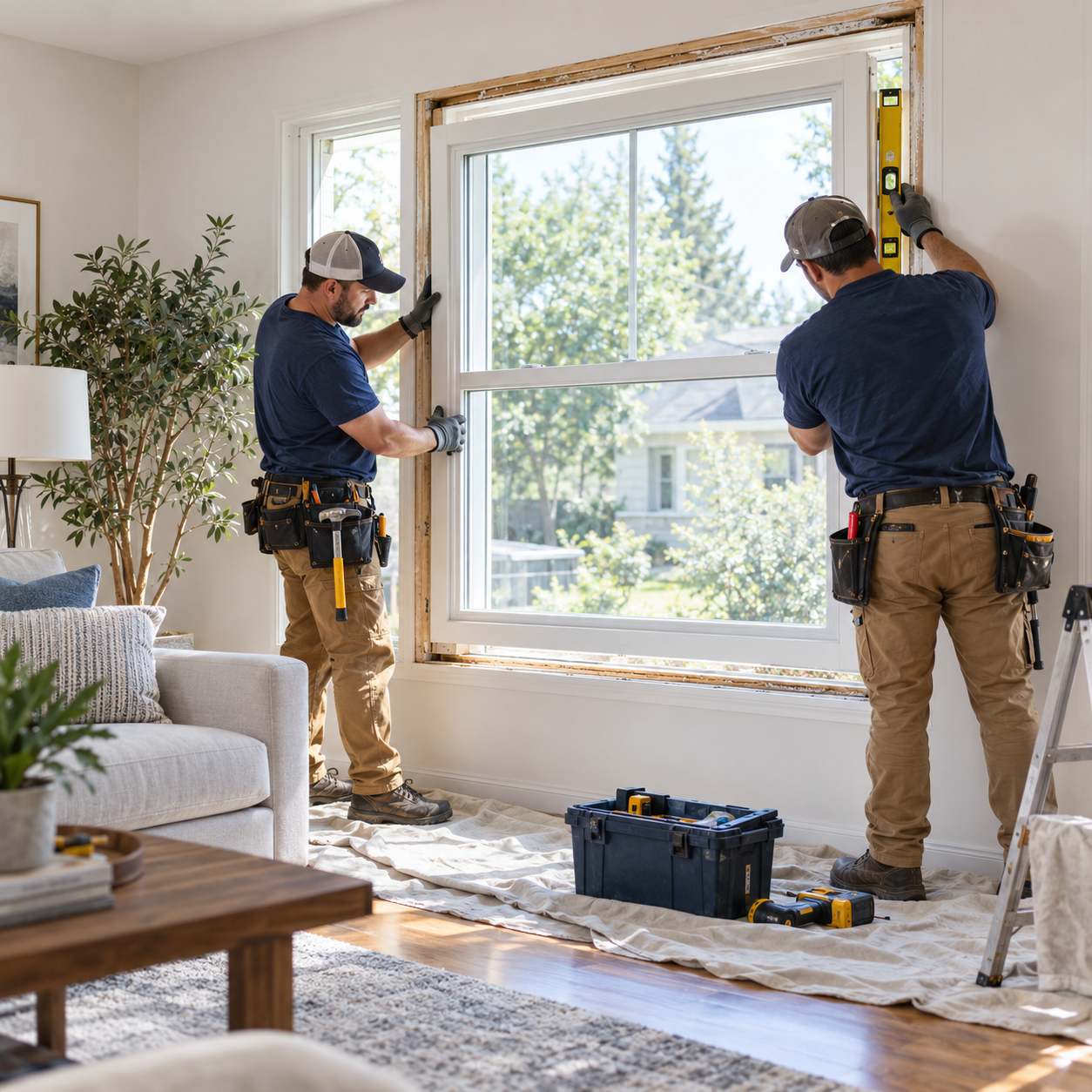

The going rate for window installation is $400 to $900 per window including both materials and labor, or $100 to $300 per window for labor alone on a standard insert replacement where the existing frame stays in good condition. Labor-only pricing also appears as an hourly rate of roughly $50 to $65 per hour on straightforward work. Full-frame replacement labor runs $300 to $600 or more per window, and second-story or architecturally shaped openings run $600 or more per window. Impact-rated windows sit above all of those figures because the glass is heavier, the attachment is engineered, and the installation has to pass inspection. Below we break the rate into its parts, show what the labor actually covers, explain why two quotes for the same house can differ by thousands, and lay out exactly which line items belong on an estimate before you sign it.
Key Takeaways
- Installed window pricing nationally runs $400 to $900 per window, with labor accounting for $100 to $300 of that on a standard insert replacement.
- Hourly labor on routine insert work runs about $50 to $65 per hour, though most replacement work is priced per opening rather than per hour.
- Full-frame installation costs $300 to $600 or more per window in labor because the opening is taken down to the framing and rebuilt.
- Homewyse puts the national basic install cost at $669 to $1,023 per window as of September 2026, while This Old House's 2026 survey of 1,000 homeowners reported $517 per window and $7,183 per project.
- Frame material moves the number: aluminum averaged $453, vinyl $472, composite $513, wood $544, and fiberglass $564 per window in that survey.
- Hurricane impact windows run $1,200 to $2,000 or more per window installed, reflecting laminated glass, engineered attachment, permitting, and inspection.
- Read the quote line by line, because 27 percent of surveyed homeowners paid more than their original estimate and 14 percent hit unexpected costs mid-project.
What Is the Going Rate for Window Installation?
The going rate for window installation is $400 to $900 per window installed, covering both the window unit and the labor, with labor alone accounting for $100 to $300 per window on a standard insert replacement. Two numbers exist because two different jobs get quoted under the same phrase.
Installed pricing means the contractor supplies the window and performs the work, so the figure contains the unit, the hardware, the fasteners and sealants, the crew time, the disposal, and the overhead. Labor-only pricing means the homeowner supplies the window and pays the installer for crew time alone. Crew time by itself is a much smaller number, which is why a homeowner comparing a labor-only quote against an installed quote often concludes one contractor is three times more expensive than another when the two are pricing entirely different scopes.
Project averages give a second reference point. The overall per-window project average lands near $750 across the typical mix of openings, and a whole-house replacement of 10 to 12 windows commonly runs $4,500 to $20,000 or more depending on frame material and glass package. Those two figures bracket most residential work in the country, with impact-rated projects in coastal markets sitting above the top of the range.
What Does Window Installation Labor Include?
Window installation labor includes removing the old unit, preparing and squaring the opening, setting and shimming the new window level and plumb, fastening it to the framing, flashing and sealing the perimeter, insulating the gap, finishing the interior and exterior edges, and hauling away the debris. Each of those steps is billable work, and a quote that comes in far below market usually leaves several of them out.
Perimeter work carries more weight than most homeowners expect. Flashing and sealing the perimeter is what keeps wind-driven rain from reaching the wall cavity, and a window set perfectly level with a poorly sealed perimeter will leak within a season. Leaks that start at the perimeter rarely announce themselves at the window, which is why they surface as stained drywall two rooms over.
Permitting adds labor that national averages tend to omit. In Florida the installer pulls the permit, submits the product approval numbers, meets the inspector on site, and corrects anything the inspection flags. Meeting an inspector costs crew hours regardless of whether a line on the estimate names them. Reviewing the common installation mistakes that fail inspections shows exactly where those hours go.
How Much Do Window Installers Charge Per Hour?
Window installers charge roughly $50 to $65 per hour for standard insert replacement labor, though most replacement work is quoted per opening rather than per hour. Per-opening quoting protects both sides, because the homeowner knows the number in advance and the installer absorbs the risk of a slow opening.
Minimum charges apply at the low end. Homewyse's estimating model builds in a two-hour minimum labor charge, which means a single small window costs more per unit than the same window installed as part of a larger run. Larger runs spread mobilization, setup, and cleanup across more units, and that spread is the entire mechanism behind volume pricing.
What Is the Average Cost to Install a Window?
The average cost to install a window is $517 per window according to This Old House's 2026 survey of 1,000 homeowners, $669 to $1,023 per window according to Homewyse's September 2026 national estimating data, and $400 to $900 per window according to the installed-price figures Google currently surfaces from Angi. Those three numbers do not conflict. They measure different things.
Survey figures report what homeowners actually paid, which skews toward the budget and mid-range products most households buy. Estimating models report what a mid-range job should cost under normal site conditions, which includes line items a homeowner may never see broken out. Site conditions are the variable neither number can hold constant, and that is why your quote will land somewhere inside the spread rather than on any single published average. Our full breakdown of window installation costs runs the same figures across every window type.
Material choice explains much of the spread. The table below reflects the per-window averages reported in the This Old House 2026 survey.
Third lite, added weight and hardware load
Aluminum sitting at the bottom of that national table surprises Florida homeowners, because aluminum dominates the impact market here at prices well above the national aluminum average. The explanation is glass rather than frame. A deeper look at vinyl frames against the alternatives shows how material and glazing interact once the product has to carry a wind load rating.
Why Do Window Installation Quotes Vary So Much?
Window installation quotes vary so much because six variables move the labor side of the number independently of the window itself: installation method, opening size, access and story height, wall construction, product performance rating, and local code requirements. Two contractors quoting the same address can price two genuinely different scopes of work.
Ranked by how much they move the labor line, those six variables sort out like this:
- Installation method. Full-frame work takes the opening down to the framing and rebuilds it. Insert work does not. The gap between the two is the single largest labor variable on most jobs.
- Wall construction. A masonry opening requires different anchors, different tooling, and stucco cut-back and patch that a wood-framed wall never needs.
- Access and story height. Second-story openings bring ladders, scaffolding, or lifts, plus the extra crew needed to handle a heavy unit at height.
- Product rating. Impact-rated assemblies carry engineered fastener patterns, specified embedment depths, and documented product approvals.
- Opening size and shape. Oversized, arched, and radius openings take longer to set, seal, and finish than a standard rectangle.
- Code and permitting. Jurisdictions differ in what they require for inspection, documentation, and finish repair.
Documentation requirements vary more than homeowners expect between neighboring jurisdictions. Jurisdiction differences show up on the estimate as a permit line, an inspection line, or nothing at all, which is one reason two quotes can look thousands apart before a single window is ordered.
Does Window Size Affect Installation Cost?
Yes, window size affects installation cost, because a larger unit weighs more, requires more installers to set safely, and takes longer to shim, fasten, flash, and finish. Weight scales faster than dimensions, since adding height and width adds glass area in both directions at once.
Shape matters alongside size. Arched, trapezoidal, and radius-top openings need custom units, custom trim, and slower finish work, and a single architectural shape can cost more in labor than three standard openings combined.
How Much Does It Cost to Install a Second-Story Window?
Installing a second-story window costs $600 or more per window in labor, compared with $100 to $300 for a comparable ground-floor insert replacement. Height is the reason, not complexity in the window itself.
Elevated work brings equipment and crew size into the price. Scaffolding or a lift has to be rented, positioned, and moved between openings, and a heavy unit lifted to height needs two or more installers working together rather than one working alone. Crew size multiplied by setup time is what pushes the elevated rate past the ground-floor rate.
What Is the Difference Between Insert and Full-Frame Window Installation?
The difference between insert and full-frame window installation is that an insert replacement fits a new window inside the existing frame, while a full-frame replacement removes the entire assembly down to the rough opening and rebuilds the connection to the structural framing. The method decides the labor hours, the finish work, and the inspection path.
Insert replacement keeps the existing frame, exterior trim, and interior casing in place, so the crew replaces the sash, glass, hardware, and weatherstripping without disturbing the wall. Leaving the wall undisturbed is what makes the method fast and inexpensive, and it costs a small amount of visible glass area because the new frame sits inside the old one.
Full-frame replacement exposes the rough opening. An exposed rough opening lets the installer inspect the framing for rot or damage, install proper flashing, and fasten the new unit directly to structure. Direct-to-structure attachment is what engineered wind load ratings depend on, which is why Florida impact projects are almost always full-frame rather than insert.
How Much More Does Full-Frame Installation Cost Than Insert?
Full-frame installation costs $150 to $300 more per window than an insert replacement, with full-frame labor running $300 to $600 or more per window against $100 to $300 for insert labor. The added charge buys tear-out, framing inspection, flashing, and finish repair on both sides of the wall.
Finish repair accounts for much of that gap. Removing the old assembly disturbs the interior casing and the exterior trim or stucco, and restoring both takes trade time that an insert job never incurs. Trade time spent on finish work is real labor, so a full-frame quote that shows no finish line deserves a question before signing.
How Much Does Impact Window Installation Cost in Florida?
Impact window installation in Florida costs $1,200 to $2,000 or more per window installed, with the range extending to roughly $2,500 per opening for larger casement and architectural units. Specialized glass, engineered frames, and local permitting account for the distance between that figure and the national going rate.
High Velocity Hurricane Zone requirements raise the bar further. Miami-Dade and Broward counties fall inside the HVHZ, where products must carry a Miami-Dade Notice of Acceptance (NOA) certifying testing to stricter impact and pressure standards. Stricter certification narrows the product field and adds documentation to every permit package. Our impact window pricing breakdown walks through how those requirements show up on a South Florida estimate.
The return side of the number is unusual for a home improvement. Florida Statute 627.0629 requires every property insurer in the state to discount the windstorm portion of the premium for homes with documented impact-rated opening protection, with credits ranging from 10 to 45 percent depending on the combination of mitigation features. We install impact windows and doors as complete openings precisely because the credit evaluates every opening together rather than one at a time.
Why Do Impact Windows Cost More to Install?
Impact windows cost more to install because laminated glass makes each unit substantially heavier, the frames are reinforced, the anchors follow an engineered fastener pattern, masonry openings often need a pressure-treated buck, and every installation passes a building department inspection. Each of those adds crew hours that a standard replacement does not require.
Weight sets the pace of the work. A laminated unit can take two installers to lift and position where a standard window takes one, and a large impact sliding glass door panel can weigh several hundred pounds. Several hundred pounds at an opening means slower, more deliberate setting, which is reflected in the per-opening labor figure rather than in the product price.
Masonry walls add a second layer of work. Concrete block openings in this region frequently need the stucco cut back, a buck installed, and the stucco patched and finished after the window is set. Patch and finish work follows a cure schedule, so it also stretches the calendar rather than only the budget. A full impact window installation accounts for all of it before the first unit is ordered.
Does a Window Installation Quote Include the Permit?
A window installation quote includes the permit only when the estimate names it as a line item. Permit and inspection fees sit outside most published cost estimates, including Homewyse's national model, which excludes them explicitly.
Florida requires a permit for window replacement, so the cost exists whether or not the quote shows it. Showing it is the difference between a complete estimate and a number that grows later. We pull permits and schedule inspections as part of the project, and the line appears on the estimate so nothing arrives as a surprise at the end.
What Should Be Itemized on a Window Installation Quote?
A window installation quote should itemize the product and its performance rating, the installation method, tear-out and disposal, flashing and sealant, interior and exterior finish repair, permit and inspection fees, the labor warranty, and the payment schedule. Anything left unnamed is a candidate for a change order.
Work through this list before signing anything:
- Product line, model, and the Florida Product Approval or Miami-Dade NOA number for each unit.
- Whether the scope is insert or full-frame, stated plainly rather than implied.
- Removal and haul-away of the old units, including the dump fee.
- Flashing, perimeter sealant, and insulation materials.
- Interior casing and exterior trim or stucco repair after installation.
- Permit fees, inspection coordination, and any required engineering.
- Labor warranty length, separate from the manufacturer's product warranty.
- Lead time for the units and the expected install window.
Supervision structure belongs on the list too. Homewyse adds 13 to 22 percent to a project total when a general contractor organizes and supervises the work rather than performing it, which is a meaningful share of the final number. Companies running their own crews carry that function internally instead, and knowing which structure you are buying makes two quotes comparable. Our guidance on choosing an installer covers the questions that reveal it quickly.
What Hidden Costs Come Up During Window Installation?
The hidden costs that come up during window installation are rot or termite damage found inside the opening, out-of-square openings that need correction, interior and exterior finish repair, disposal fees, and stucco or masonry patching. Each surfaces after demolition, which is why they rarely appear on the first estimate.
Published research puts numbers to the pattern. In the This Old House 2026 survey, 27 percent of homeowners paid more than their original quote, 14 percent reported unexpected costs during the project, 11 percent needed follow-up work, and 9 percent had damage to walls or trim. Wall and trim damage happens most often when an opening is taken apart by a crew that priced the job as a straight swap.
Preventing surprises costs very little at the front end. Ask the contractor how the contract handles concealed conditions, and request that an allowance for rot repair appear in writing before work begins. An allowance written in advance converts a mid-project negotiation into a scheduled line item, and replacing old windows that have been leaking for years makes that allowance worth asking for.
Is It Cheaper to Buy Windows and Have Someone Install Them?
Buying windows yourself and hiring someone to install them is cheaper on paper and more expensive in practice for most homeowners, because the savings on the unit come with the risk of a measurement error, a product that fails local approval, and a split warranty. Split warranties are the real exposure.
Responsibility is what separates the two arrangements. Under supply-and-install, one company measures, orders, installs, and warrants the result, so a unit that arrives wrong gets replaced at the contractor's cost. Under labor-only, the homeowner owns the measurement, and a window ordered a half inch too wide becomes a restocking fee plus a second lead time plus a second mobilization.
Product approval adds a Florida-specific risk. A window bought off a shelf may not carry the approval the local building department requires for your wind zone, and an installer cannot pass inspection with an unapproved product. Failed inspections cost more than the original savings, which is also the core problem with DIY installation on impact-rated openings.
How Much Does It Cost to Install 10 Windows?
Installing 10 windows costs roughly $4,500 to $9,000 for standard units at national going rates, and $12,000 to $20,000 or more for impact-rated units in Florida. The spread tracks frame material, glass package, and installation method rather than the count itself.
Project-level survey data lands inside that bracket. This Old House reported an average project cost of $7,183 across an average project size of 7 windows in 2026, which works out close to the per-window averages in the table above. Project size itself has been shrinking, dropping from about 9 windows in early 2025 to 7 in 2026, as more households replace in stages.
Is Installation Cheaper If You Replace All Windows at Once?
Yes, installation is cheaper per window if you replace all windows at once, because mobilization, permitting, setup, and project management are fixed costs spread across every opening in the job. Spreading fixed costs is the mechanism behind every volume discount in the trade.
Staged replacement carries a second cost that rarely appears in a budget. Each stage means another permit, another mobilization, and another round of disruption, and in Florida a partial impact installation leaves openings unprotected, which affects how the wind mitigation form scores the home. Whole-home scoring is all or nothing on opening protection, so finishing every opening is what unlocks the full credit.
How Long Does It Take to Install a Window?
Installing a window takes 30 to 60 minutes for a standard insert replacement and 1 to 2 hours for a full-frame impact installation, with a whole-home project of 10 to 15 openings typically running 1 to 3 days. Crew size and opening complexity set the pace.
Impact work runs longer per opening because the unit is heavier, the fastener pattern is specified, and the perimeter has to be sealed to a documented detail. Documented details get verified at inspection, which is time well spent given what the inspection protects. Our breakdown of the installation schedule covers how those hours stack up across a full house.
What You Get Back for the Going Rate
What you get back for the going rate is resale value, lower energy use, and in Florida a documented reduction in the windstorm portion of your insurance premium. Three returns stack on one purchase, which is unusual for an exterior improvement.
Resale recovery is measurable. The Cost vs Value report, compiled annually and now published by the Journal of Light Construction, puts vinyl window replacement at roughly 67 to 69 percent of cost recouped at resale nationally. Energy performance adds to that over the holding period, since the U.S. Department of Energy attributes 25 to 30 percent of a home's heating and cooling energy use to its windows.
Insurance is where Florida separates from the national picture. Documented impact-rated opening protection triggers the windstorm discount required by Florida Statute 627.0629, which runs 10 to 45 percent depending on the full set of mitigation features on the inspection form. Across Miami-Dade, Broward, Palm Beach, and Lee counties, that annual credit continues for the life of the product. Available rebates and incentives reduce the upfront number as well.
Pairing openings with the rest of the envelope compounds the effect. A complete window and door replacement earns the highest opening protection credit available on the mitigation form, because the form evaluates windows, doors, skylights, and garage doors as a single category.
Frequently Asked Questions
How Much Should I Charge Someone to Install Windows?
Installers generally charge $100 to $300 per window for standard insert labor, $300 to $600 or more per window for full-frame work, and $600 or more per window for second-story or architecturally shaped openings. Hourly labor on routine work sits near $50 to $65 per hour. Rates shift with regional labor costs, licensing requirements, and whether the installer carries the permit and inspection responsibility.
Should You Get Multiple Window Installation Quotes?
Yes, you should get multiple window installation quotes, and three is a practical number. Compare them on identical scopes rather than bottom-line price, checking that each quote names the same installation method, the same product rating, and the same finish work. A lower number attached to a smaller scope is not a discount.
Is DIY Window Installation Cheaper Than Hiring an Installer?
DIY window installation is cheaper upfront and more expensive over time for most homeowners. Installation errors produce air leaks, water intrusion, and voided manufacturer warranties, and the repair costs exceed the labor that was avoided. In Florida the calculation is simpler still, since permitted impact window work requires a licensed contractor and a passed inspection.
What Questions Should You Ask a Window Installer About Price?
Ask a window installer whether the quote is insert or full-frame, whether permit and inspection fees are included, what the disposal and finish repair cover, how concealed damage inside the opening is handled, how long the labor warranty runs, and whether the crew is employed by the company or subcontracted. Ask for the product approval number as well, since the approval determines whether the window passes inspection in your wind zone.
What Time of Year Is Window Installation Cheapest?
Window installation is generally cheapest during slower demand periods, which in Florida fall between late fall and early spring rather than during the run-up to hurricane season. Scheduling in the off-peak months improves crew availability and lead times. Product pricing follows manufacturer cycles rather than the season, so the savings show up in scheduling flexibility more than in the unit price.
The Bottom Line
The going rate for window installation is a range rather than a figure: $400 to $900 per window installed nationally, $100 to $300 per window for standard insert labor, $300 to $600 or more for full-frame labor, and $1,200 to $2,000 or more per opening for impact-rated work in Florida. Where your project lands inside that range depends on installation method, wall construction, access, product rating, and local code, not on who happens to quote the lowest number first.
Compare quotes on scope rather than total. A complete estimate names the product and its approval number, states whether the work is insert or full-frame, includes tear-out and disposal, covers flashing and finish repair, lists the permit, and puts a number of years on the labor warranty. Estimates built that way rarely grow after demolition starts.
We have been installing windows and doors across South Florida since 2006 with licensed, in-house crews, and we are glad to walk your openings and put a line-item number in front of you. ASP SuperHome prices the work the way it gets performed, with nothing held back for a change order later.
Reach out whenever you want that walkthrough scheduled through our contact us page.
Meet With a Project Manager
Your first conversation is with a Project Manager who takes the time to understand your goals, walk you through your options, and stays connected throughout your project — from the initial consultation through the final walkthrough.
.avif)
.avif)
.avif)
%201.avif)
Insights & Resources
Stay informed with expert tips on roofing materials, hurricane codes, repairs, and South Florida construction standards.


%201.avif)
%201%20(1).avif)

%201.svg)
%201%20(1)%20(1).png)
.png.png)
.png%20(1).png)
.png%20(2).png)
.avif)
.avif)


.png)
.svg)
.png)