


Impact Windows vs Hurricane Shutters
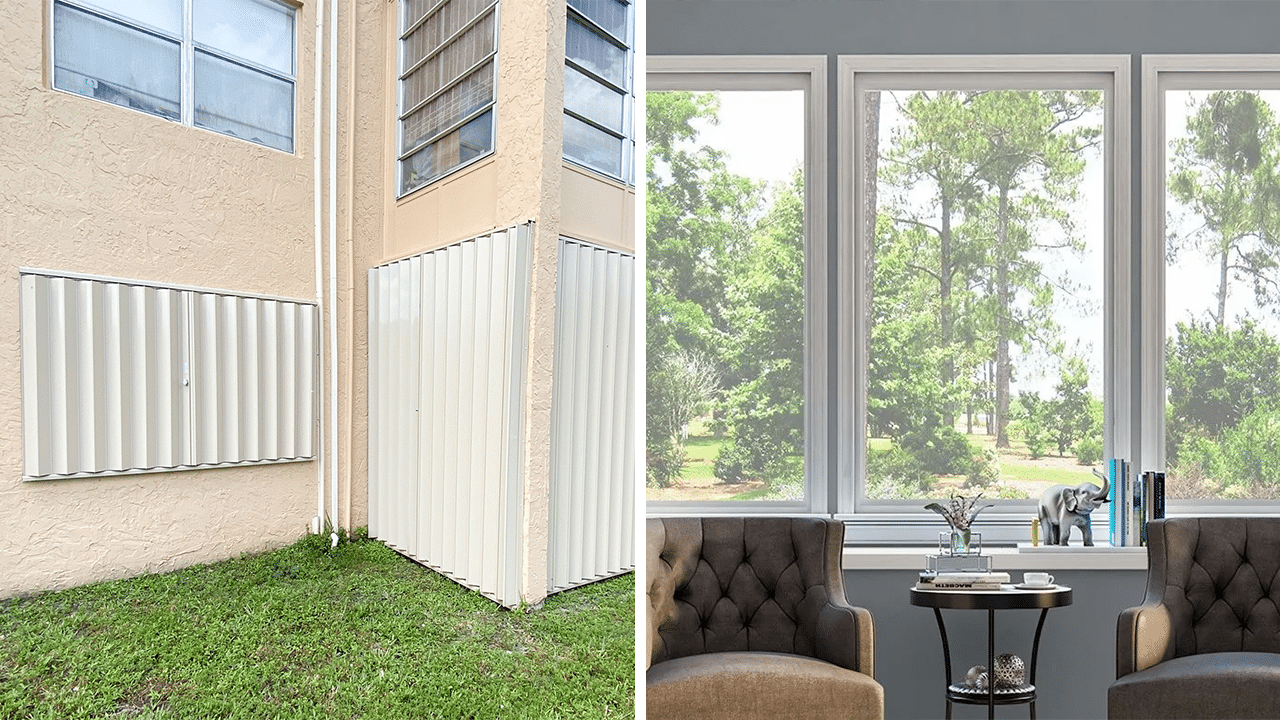

Impact windows offer permanent, always-on storm protection built right into your home, while hurricane shutters are separate coverings that must be closed and locked before every storm. Both options meet Florida Building Code requirements and protect against high winds and flying debris, but they work very differently in daily life, cost, energy savings, insurance discounts, and long-term value. This guide breaks down every major difference so you can make the right decision for your home and budget.
How Do Impact Windows and Hurricane Shutters Compare?
Impact windows and hurricane shutters both protect your home during a storm, but they do it in completely different ways. Impact windows replace your existing windows entirely. They use two panes of glass bonded together with a strong polyvinyl butyral (PVB) or ethylene-vinyl acetate (EVA) interlayer, all held inside a heavy-duty frame. If the glass cracks from debris, the interlayer holds it in place. Your home stays sealed.
Hurricane shutters, on the other hand, are separate coverings that go over your existing windows. They come in several styles, including accordion, roll-down, Bahama, colonial, and aluminum storm panels. Shutters create a barrier between the storm and your glass, but they only work when someone closes and locks them before the storm arrives.
According to the National Oceanic and Atmospheric Administration (NOAA), the U.S. experienced 27 billion-dollar weather disasters in 2024 alone, causing $182.7 billion in total damages. CoreLogic's 2024 Hurricane Risk Report estimates 32.7 million homes are at risk of hurricane damage across the country. With numbers like these, picking the right protection matters.
Are Impact Windows as Good as Hurricane Shutters?
Yes, impact windows are as good as hurricane shutters for storm protection, and in many ways, they are better. Both products are tested and approved under the Florida Building Code to resist high winds and flying debris. The key difference is that impact windows work around the clock, every single day, without you lifting a finger.
Hurricane shutters only protect your home when they are deployed. If a storm develops quickly and you are away from home, at work, or simply run out of time, your shutters stay open and your windows stay exposed. According to NOAA data, hurricane damage does not increase at a steady rate with wind speed. It increases exponentially. A jump from 75 mph to 150 mph does not double the damage. It multiplies it by a factor of roughly 256. That is why having permanent protection in place at all times is such a big deal.
Many homeowner associations in South Florida also restrict when you can have shutters closed. You typically cannot keep them up outside of an active storm watch or warning. Impact windows have no such restriction because they look and function like regular windows every day.
Can Impact Windows Withstand Category 5?
Yes, most high-quality impact windows can withstand Category 5 hurricane conditions. Category 5 is the highest level on the Saffir-Simpson Hurricane Wind Scale, with sustained winds of 157 mph or higher. Impact windows are not rated by hurricane category directly. Instead, they receive a Design Pressure (DP) rating, which measures the maximum air pressure (in pounds per square foot) the window can handle without failing.
According to the American Society for Testing and Materials (ASTM), impact windows must pass two critical tests under ASTM E1886 and E1996 standards. First, a 9-pound piece of 2x4 lumber is fired at the glass at 50 feet per second (about 34 mph) to simulate flying debris. Then the window is put through thousands of cycles of changing positive and negative pressure to simulate sustained hurricane winds. A window with a DP rating of 50 or higher can handle wind speeds well above 157 mph, making it effective in Category 5 conditions.
Proper installation plays a major role. A strong window installed incorrectly can still fail. That is why working with a licensed contractor who follows code requirements is so important. Residential impact windows installed to code give your home the best possible chance of riding out even the strongest storms.
What Types of Hurricane Shutters Are Available?
Hurricane shutters come in several styles, each with different features and price points. Accordion shutters fold out from the sides of the window and lock in the center. They are one of the most popular options because they are fairly easy to deploy and offer solid protection. Roll-down shutters operate with a crank or motor and roll down from a housing above the window. They are the most convenient shutter option but also the most expensive.
Bahama shutters are hinged at the top and prop outward, giving your home a tropical look while providing shade. Colonial shutters are hinged on each side of the window and swing closed like traditional plantation-style shutters. Aluminum storm panels are the most affordable option. They are flat sheets of corrugated metal or clear polycarbonate that bolt or clip onto tracks around the window frame. Storm panels work well for protection but take the most time and effort to install before a storm.
All of these styles can be Florida Building Code approved for hurricane protection when they meet the required testing standards. The main trade-off with every shutter type is that someone needs to physically set them up before the storm arrives.
How Do Impact Windows and Hurricane Shutters Compare on Storm Protection?
Both impact windows and hurricane shutters provide excellent protection during a hurricane when properly installed. The Florida Building Code requires both products to meet strict wind load and impact resistance standards for the specific location where they are installed. Neither product is automatically safer than the other in terms of raw protection.
The real difference is reliability. Impact windows are always in place. They protect your home from wind, debris, rain, and even break-in attempts 24 hours a day, 365 days a year. Hurricane shutters only protect when someone deploys them. If you forget, if you are on vacation, or if the storm turns and hits faster than expected, your shutters are useless sitting open against the wall. Research from FEMA shows that even moderate storms can produce sudden wind gusts and debris impacts strong enough to break unprotected standard glass.
For homeowners who spend time away from their home or who simply want peace of mind without the stress of storm prep, impact windows are the clear winner for protection reliability.
Can 70 Mph Winds Break Windows?
Yes, 70 mph winds can break standard windows. Regular single-pane and even many double-pane windows are not built to handle wind speeds that high, especially when the wind carries flying debris like tree branches, roof tiles, or loose objects. A tropical storm reaches 39 mph, and a Category 1 hurricane starts at 74 mph. At 70 mph, you are already in dangerous territory for unprotected glass.
Impact windows, however, are designed and tested to handle winds far beyond 70 mph. Most products on the market are rated for sustained winds of 150 mph to 200 mph or more, depending on the manufacturer and the DP rating. The laminated glass and reinforced frame work together to absorb the energy from both wind pressure and debris strikes without letting the wind and rain into your home.
How Hard Is It to Break Hurricane Glass?
Hurricane glass is extremely hard to break. Impact-resistant glass is made of two layers of tempered or heat-strengthened glass bonded together with a tough PVB or EVA interlayer. Even if the outer layer of glass cracks or shatters on impact, the interlayer holds all the pieces in place, much like a car windshield. The glass may spider-web, but it does not fall apart or create an opening.
During ASTM testing, impact windows must survive a direct hit from a 9-pound 2x4 lumber projectile fired at the glass, followed by 9,000 cycles of intense pressure changes. This makes hurricane glass one of the toughest glazing products available for residential use. Standard windows fail almost immediately under the same conditions.
Do Impact Windows Reduce Energy Bills?
Yes, impact windows reduce energy bills significantly. According to the U.S. Department of Energy, heat gain and heat loss through windows account for 25% to 30% of residential heating and cooling energy use. In a state like Florida, where air conditioning runs nearly year-round, that number adds up fast.
Impact windows with Low-E (low-emissivity) coatings can filter out 40% to 70% of heat that normally passes through glass, according to the Department of Energy's window technology research. ENERGY STAR reports that certified windows can save homeowners up to 13% on their heating and cooling bills. The U.S. Department of Energy also estimates that replacing old windows with energy-efficient impact windows can save up to $465 per year.
Hurricane shutters, by contrast, provide zero energy savings. They are only closed during storms and sit open or stored away the rest of the year. They do not insulate, block UV rays, or reduce heat transfer in any measurable way during normal daily use.
Do Impact Windows Increase Home Value?
Yes, impact windows increase home value. According to data from the National Association of Realtors, impact windows return 65% to 85% of their installation cost in added property value. A typical $25,000 installation can add $16,250 to $21,250 to your home's appraised value.
In hurricane-prone markets like Miami-Dade and Broward counties, the return can climb even higher because buyers expect storm protection as a standard feature, not a luxury upgrade. Research cited by Florida real estate professionals shows that homes with impact windows sell up to 20% faster than homes without them. Upgrading to hurricane-rated windows is one of the smartest moves a homeowner can make before listing a property. The 2025 Remodeling Cost vs. Value Report found that window replacement projects in the South Atlantic region recoup between 67% and 72% of their cost at resale.
Hurricane shutters add some value, but significantly less. Buyers see shutters as a temporary fix, not a permanent upgrade. They know that shutters still require old windows behind them, and old windows eventually need replacement on their own.
Can Burglars Break Impact Windows?
No, burglars cannot easily break impact windows. The same laminated glass and reinforced frame that stop hurricane debris also make forced entry extremely difficult. A standard window can be broken in seconds with a simple tool. Impact glass resists repeated blows and stays intact even when cracked, making it nearly impossible for someone to create an opening large enough to climb through.
This is a major advantage over hurricane shutters. Shutters are only closed during storms, which means they provide zero break-in protection the other 360+ days of the year. Impact windows give you year-round security. Paired with impact doors, your home becomes a much harder target for intruders every single day.
Impact Windows vs Hurricane Shutters: Side-by-Side Comparison
FeatureImpact WindowsHurricane ShuttersProtection TypePermanent, always activeDeployment required before each stormWind ResistanceUp to 200+ mph (varies by DP rating)Up to 180+ mph (varies by product)Energy SavingsUp to 13% on heating/cooling (ENERGY STAR)NoneNoise ReductionSTC rating 32-40+ (significant reduction)Only when closed during stormsUV ProtectionBlocks up to 99% of UV rays year-roundOnly when closedSecurityYear-round break-in resistanceOnly when deployedInsurance Discount (Wind Portion)25% to 45%15% to 35%Home Value ROI65% to 85% (National Association of Realtors)Lower, varies by typeAverage Lifespan25 to 30+ years15 to 25 yearsSetup Before StormsNone requiredManual deployment needed
Sources: U.S. Department of Energy, ENERGY STAR, National Association of Realtors, Florida Department of Financial Services, ASTM International
How Long Do Impact Windows and Hurricane Shutters Last?
Impact windows typically last 25 to 30 years or more with proper care. The laminated glass and reinforced frames are built to withstand decades of sun, rain, wind, and salt air exposure. Many manufacturers offer warranties that cover the glass and frame for 10 to 25 years or longer. With regular cleaning and occasional seal inspections, hurricane windows can last well beyond their warranty period.
Hurricane shutters generally last 15 to 25 years, depending on the type and material. Aluminum accordion and roll-down shutters tend to last longer because they are more durable. Storm panels, especially those stored and reinstalled repeatedly, can bend, corrode, or lose their hardware over time. All shutters need regular maintenance, including lubricating tracks, checking fasteners, and inspecting for corrosion from salt air. A shutter that does not deploy smoothly in an emergency is not a shutter you can count on.
In South Florida, where sun, humidity, and salt air are constant, the long lifespan and low maintenance of impact windows make them a better long-term investment for most homeowners.
Do Impact Windows Help Lower Insurance in Florida?
Yes, impact windows help lower homeowners insurance in Florida. Under Florida Statute 627.0629, insurance companies are required to provide actuarially reasonable discounts for verified wind mitigation upgrades. According to the Florida Department of Financial Services, homeowners can receive 10% to 45% off their windstorm insurance premiums for approved upgrades like impact windows and hurricane shutters.
Both products qualify for the opening protection credit on the OIR-B1-1802 wind mitigation inspection form. However, impact windows typically earn larger and more consistent discounts because they protect the openings permanently. Insurance companies assess risk based on the permanence of your protection. A shutter that is not deployed offers no protection and, in many cases, no insurance credit during an actual event.
On a typical South Florida policy, the difference between shutter discounts and impact window discounts can range from $500 to $1,500 per year. Over a decade, that savings adds up significantly. Florida's My Safe Florida Home program also offers matching grants of up to $10,000 for qualifying hurricane protection upgrades, including impact windows. Homeowners can learn about window rebates and other incentive programs that help offset upgrade costs. The program received $352 million in funding for the 2025-2026 cycle.
How to Choose Between Impact Windows and Hurricane Shutters
The right choice depends on your budget, your lifestyle, and the age of your current windows. If your existing windows are more than 15 to 20 years old, you are likely going to need new windows soon anyway. In that case, getting impact windows is often more affordable than buying both new standard windows and separate hurricane shutters. The general rule of thumb for window replacement says the average window needs replacing within 20 to 30 years of installation.
If your budget is tight and your current windows are still in good shape, hurricane shutters can provide solid storm protection at a lower upfront cost. Shutters at 30% to 50% of the cost of full impact window replacement make them a reasonable short-term solution for homeowners who need hurricane preparedness now but cannot afford a full window replacement yet.
Think about convenience too. If you travel often, have mobility issues, or simply do not want the stress of putting up shutters every time a storm threatens, impact-resistant windows remove that burden entirely. You never have to do anything. Your home is protected the moment the windows are installed and every day after that.
Consider the full picture of value. Impact windows save money on energy bills, boost your home's resale price, lower insurance premiums by a larger margin, reduce outside noise, and block UV damage to your furniture and flooring. Shutters do one job, and they do it only during storms.
Frequently Asked Questions
Does Putting Duct Tape on Windows Help During a Hurricane?
No, putting duct tape on windows does not help during a hurricane. This is one of the most common storm myths. Tape does not strengthen glass in any way. It will not prevent the window from breaking, and it will not stop wind or debris from entering your home. In fact, taped glass can break into larger, more dangerous shards instead of smaller pieces. The Federal Alliance for Safe Homes (FLASH) and FEMA both advise against taping windows. The only effective options for window protection are impact-resistant glass or code-approved hurricane shutters.
Should You Crack Open Your Windows During a Hurricane?
No, you should not crack open your windows during a hurricane. This is another widespread myth. The idea was that opening windows would equalize pressure inside the home and prevent the roof from blowing off. Research from the Institute for Business and Home Safety (IBHS) has shown this is false. Opening windows actually lets wind and rain inside, which increases internal pressure and makes roof failure more likely, not less. Keep all windows and doors closed and locked during a hurricane.
What Should You Do If a Window Blows Out During a Hurricane?
If a window blows out during a hurricane, you should move to an interior room with no windows immediately. Do not try to cover the opening during the storm because flying debris and extreme wind make it too dangerous. Close the door to the room with the broken window to slow wind flow through the house. After the storm passes, cover the opening with plywood or heavy plastic sheeting as a temporary fix and contact a licensed contractor for proper repair or replacement.
Do You Still Need Hurricane Shutters If You Have Impact Windows?
No, you do not need hurricane shutters if you have impact windows that meet Florida Building Code requirements. Impact windows are a complete, code-approved solution for opening protection on their own. Some homeowners choose to add shutters over impact windows for an extra layer of protection, but it is not required by code or by insurance companies. Your impact windows alone will qualify you for the opening protection discount on your wind mitigation inspection.
Are There Grants for Impact Windows in Florida?
Yes, there are grants for impact windows in Florida. The My Safe Florida Home program, run by the Florida Department of Financial Services, provides matching grants of up to $10,000 for hurricane protection upgrades. For every $1 a homeowner spends, the state contributes $2, up to the $10,000 cap. The program received $352 million in funding for 2025-2026 and is available on a first-come, first-served basis to eligible homeowners.
How Long Does It Take to Install Impact Windows?
Impact window installation typically takes one to three days for an average-sized home, depending on the number of windows and the complexity of the job. Each window usually takes one to two hours to install. Factors like window size, frame condition, and whether structural modifications are needed can add time. A professional window installation crew handles the full process, from removing old windows to sealing and finishing the new ones.
Putting It All Together
Impact windows and hurricane shutters both protect your home during a storm. The right choice comes down to your budget, how old your current windows are, and how much value you want from the upgrade. Impact windows cost more upfront but deliver permanent protection, energy savings, noise reduction, UV blocking, security, higher insurance discounts, and stronger resale value. Hurricane shutters cost less but only work when deployed and offer none of those year-round benefits.
With NOAA data showing hurricanes are causing billions in damage year after year and Florida's My Safe Florida Home program putting real grant money on the table, there has never been a better time to upgrade your home's storm protection. Whether you choose impact windows, shutters, or a combination of both, the important thing is to have a plan in place before the next storm season arrives.
If you have questions or want help figuring out the best fit for your home, we are happy to walk you through your options here at ASP SuperHomes.
Give us a call anytime at 786-933-9815 to get started.
Meet With a Project Manager
Your first conversation is with a Project Manager who takes the time to understand your goals, walk you through your options, and stays connected throughout your project — from the initial consultation through the final walkthrough.
.avif)
.avif)
.avif)
%201.avif)
Insights & Resources
Stay informed with expert tips on roofing materials, hurricane codes, repairs, and South Florida construction standards.


%201.avif)
%201%20(1).avif)
%201.svg)
%201%20(1)%20(1).png)
.png.png)
.png%20(1).png)
.png%20(2).png)
.avif)
.avif)


.png)
.svg)
.png)