


What Happens During a Commercial Roof Inspection
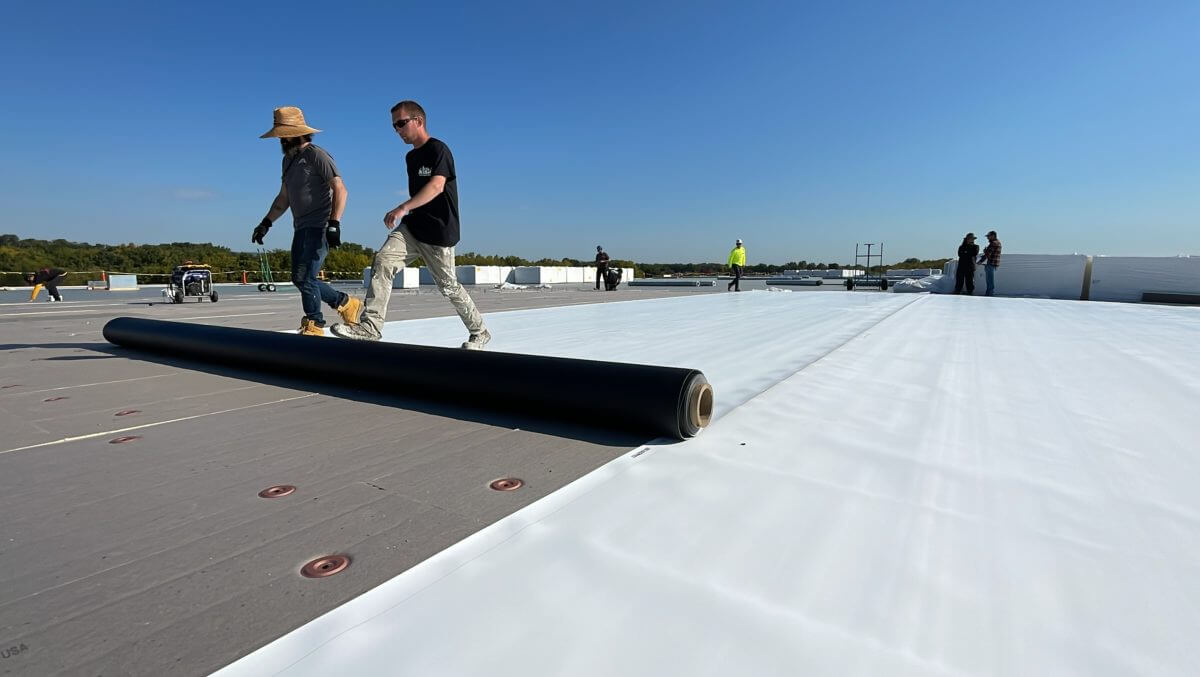

A commercial roof inspection is a documented survey of the entire roof assembly, moving from a review of the building's roofing history, to a systematic walk of the membrane surface, to close examination of every seam, flashing, penetration, and drain, and finishing with a written condition report. Larger or older roofs add infrared moisture scanning and core sampling to find water that has already worked its way beneath the surface. The whole point is to catch small, repairable defects before they turn into saturated insulation and a full replacement. Below we cover who is responsible for arranging one, the exact field sequence, the tools inspectors carry and what each one detects, what belongs on the checklist and in the report, what Florida law now requires of condominium and cooperative buildings, and how the findings translate into repair, restoration, or replacement.
Key Takeaways
- A commercial roof inspection moves through five stages: document review, surface walk, detail examination, diagnostic testing, and written reporting.
- Penetrations and flashings carry the highest failure rate per square foot of any part of a commercial roof.
- Infrared moisture surveys work during temperature transition at dawn or dusk and produce unreliable results on a uniformly wet roof.
- The most serious finding is saturated insulation beneath a membrane that still looks intact from above.
- Ponding water, defined by the NRCA as water standing 48 hours or more after rainfall, is the leading driver of that saturation.
- Florida Statute 553.899 requires milestone inspections for condominium and cooperative buildings of three or more habitable stories at 30 years, or 25 years within three miles of the coastline.
- The roof is a mandatory component of a Structural Integrity Reserve Study under Florida Statute 718.112(2)(g), and reserve funding for it can no longer be waived.
- NRCA data puts a maintained commercial roof at about 21 years of service against about 13 for a neglected one.
What Happens During a Commercial Roof Inspection?
During a commercial roof inspection, an inspector reviews the building's roofing records, walks the entire membrane surface, examines every seam, flashing, penetration, and drain, runs diagnostic testing where conditions warrant it, and delivers a written condition report with photographs and recommendations. A thorough inspection on a mid-size building runs two to four hours on the roof and produces a document that outlives the visit.
Documentation is the part that separates a real inspection from a look around. Anyone can walk a roof and say it seems fine. An inspection produces dated photographs tied to mapped locations, a condition rating for each assembly component, and a prioritized list of what needs attention now versus what can wait a season.
Scope depends on why the inspection was ordered. A routine semiannual survey looks different from a post-storm damage assessment, which looks different again from a pre-purchase due diligence review or a capital planning survey for a reserve study. Each one starts from the same field procedure and diverges in depth and reporting. We handle all four types across our commercial roofing work, and the first conversation is always about which one the building actually needs.
What Is a Commercial Roof Inspection?
A commercial roof inspection is a systematic assessment of a low-slope or flat roof assembly to determine its current condition, identify active and developing defects, and estimate remaining service life. It examines the assembly rather than the covering, which means the membrane, the insulation beneath it, the deck below that, and every detail where those layers meet something else.
Commercial inspections differ from residential ones in scale and complexity rather than in purpose. A commercial roof spans tens of thousands of square feet, carries mechanical equipment on curbs, drains through interior drains and scuppers rather than gutters, and hides its most expensive problems under the surface. A homeowner can often assess shingles from the ground. Nobody assesses a warehouse membrane from the parking lot.
The economic argument is straightforward. According to the National Roofing Contractors Association, a maintained commercial roof lasts approximately 21 years while a neglected one lasts approximately 13. That eight-year gap is the return on a habit of scheduled inspection, and the NRCA preventative maintenance study found that regular surveys extend roof service life by 30%. Building owners weighing whether inspections earn their keep are really weighing an entire replacement cycle, which is why inspection sits at the front of every maintenance program across our roofing services.
Who Is Responsible for a Commercial Roof Inspection?
Responsibility for a commercial roof inspection sits with whoever the lease or governing documents assign it to, which is the building owner in most cases, the tenant under many triple-net leases, and the association board in a condominium or cooperative. Assuming rather than checking is how roofs go five years without anyone looking at them.
Triple-net leases are the common trap. Under a full triple-net structure the tenant typically carries maintenance, taxes, and insurance on the property, and roof maintenance often falls inside that. The owner assumes the tenant is handling it, the tenant assumes a roof is the landlord's problem, and neither books an inspection. The lease language settles it, and reading that clause is worth doing before the next rainy season rather than after a leak.
Associations operate under a different framework entirely. In a condominium or cooperative, the roof is almost always a common element, and the board carries the duty to maintain it and to fund its eventual replacement. Florida law has tightened considerably around that duty, which the milestone and reserve study sections below cover in detail.
Manufacturers add a fourth party. Extended system warranties frequently require documented periodic inspection as a condition of coverage, and the manufacturer may send its own representative or may simply require that yours be performed and recorded. Skipping those inspections voids coverage quietly, with the lapse surfacing only when a claim gets denied.
What Are the Steps of a Commercial Roof Inspection?
A commercial roof inspection follows five stages in order: document review, interior survey, exterior and surface walk, detail and penetration examination, and diagnostic testing, closing with the written report. Order matters, because each stage narrows where the next one looks.
- Review the roof's history first. The inspector reads the original system specification, the product approval documents, warranty paperwork, prior inspection reports, and every repair invoice on file. A roof with four patch repairs in one quadrant tells you where to spend your time before you ever climb the ladder.
- Survey the interior. Ceiling stains, discolored insulation, corroded deck underside, and damp drywall all mark entry points, and they are visible from below at no cost. Water travels laterally, so an interior stain is a clue rather than a location, and noting it early shapes the surface walk.
- Check the perimeter from the ground. Edge metal, coping, parapet condition, scupper discharge, downspouts, and any staining on the exterior wall face get photographed before the inspector goes up.
- Walk the entire membrane surface. The full field gets covered on foot, usually in a grid pattern so nothing is skipped. The inspector notes blisters, ridging, shrinkage, punctures, surface degradation, biological growth, and any area that feels soft underfoot, because soft is what saturated insulation feels like through a membrane.
- Examine every seam, flashing, and penetration individually. Seams get probed for lifting and separation. Base flashings at curbs, parapets, and walls get checked for pulling away, cracking, and open laps. Every pipe boot, vent, drain, and equipment curb gets its own inspection, because these details fail at the highest rate on any commercial roof.
- Evaluate drainage. Drains and strainers get checked for blockage, scuppers for obstruction, and the field for evidence of standing water. Water stains, silt lines, and vegetation growth all mark where water sits after rain even on a dry inspection day.
- Run diagnostic testing where conditions warrant. Infrared scanning, moisture meter readings, and core sampling get deployed on older roofs, on roofs with a known leak, or where the surface walk found soft areas.
- Document and report. Photographs get tied to a roof plan, findings get rated by severity, and the whole thing goes into a written report with prioritized recommendations.
Two conditions make the whole sequence more productive. The roof should be reasonably dry and reasonably clear, since standing water and heavy debris both hide the defects an inspection exists to find.
What Tools Do Roof Inspectors Use?
Roof inspectors use an infrared camera, a capacitance or pin-type moisture meter, a core cutter, a seam probe, a digital camera, and increasingly a drone for visual survey of areas that are difficult or unsafe to reach. Each tool answers a different question, and none of them replaces walking the roof.
A seam probe is the least impressive and most useful item in the bag. Running a blunt probe along a welded or adhered seam finds lifting and separation that is invisible from standing height, and seams are where most membrane roofs eventually fail. Moisture meters read the presence of water in the roof assembly at a specific point, which is how a suspected wet area gets confirmed before anyone cuts into anything.
Drones have changed access rather than diagnosis. Aerial imagery documents overall condition, steep or unsafe areas, and post-storm damage across a large footprint quickly. A drone cannot probe a seam, feel a soft spot underfoot, or lift a flashing to look behind it, so it supplements a physical inspection rather than substituting for one.
What Is an Infrared Moisture Survey?
An infrared moisture survey uses a thermal camera to locate water trapped inside the roof assembly by detecting temperature differences across the surface. Wet insulation holds heat longer than dry insulation does, so as a roof cools in the evening the saturated areas stay warmer and appear as bright zones on the thermal image.
Timing controls whether the survey works at all. Scanning has to happen during a temperature transition, typically at dusk as the roof gives up the day's heat or early in the morning as it warms, because a roof at thermal equilibrium shows no differential to detect. A scan run at midday, or on a roof that is uniformly wet after recent rain or washing, produces results that are unreliable at best and misleading at worst.
What the survey delivers is a map rather than a verdict. Suspected wet areas get marked on the roof plan and then confirmed by moisture meter readings and core samples at representative points. Mapping matters because it converts a vague "the roof leaks somewhere" into a measured percentage of the roof area that is saturated, and that percentage is what decides the next step. Trapped moisture also creates moisture problems inside the building long before it becomes visible as a ceiling stain.
What Is a Core Sample and When Is One Needed?
A core sample is a small cylindrical section cut through the full roof assembly and removed for examination, revealing the number of layers, the materials in each, the insulation type, and whether that insulation is wet. The opening gets patched and sealed immediately after the sample is taken.
Cores answer questions nothing else can. Many commercial roofs carry a second system installed over the first decades ago, and the layer count determines whether another recover is permitted or whether a tear-off is required. Insulation moisture content is measurable only by removing a piece and testing it, and that measurement is the single most important number in a repair-versus-replace decision.
Sampling is targeted rather than random. Cores get taken at points the infrared survey flagged and at a control point in an area that scanned dry, so the results can be compared. Three to six cores is typical on a mid-size roof, and taking more than necessary just creates more patches.
What Is on a Commercial Roof Inspection Checklist?
A commercial roof inspection checklist covers the membrane field, all seams and laps, base and counter flashings, every penetration and curb, perimeter edge metal, drainage components, rooftop equipment, and the interior underside of the deck. The most important items are the ones where two different materials meet, because that is where nearly every failure begins.
- Membrane field. Blisters, ridges, splits, punctures, shrinkage, surface erosion, granule loss on bituminous systems, and any area that gives underfoot.
- Seams and laps. Lifting edges, separation, incomplete welds, and open laps, checked by probe rather than by eye.
- Base flashings. At curbs, parapets, walls, and expansion joints, checked for pulling away, cracking, and loss of adhesion.
- Penetrations. Pipe boots, vent stacks, exhaust fans, conduit supports, skylights, pitch pockets, and every HVAC curb. Highest failure rate per square foot on the entire roof.
- Drainage. Interior drains, strainers, scuppers, overflow provisions, and evidence of ponding such as silt lines, staining, or vegetation.
- Perimeter. Edge metal, coping, fascia, and terminations, which take the highest wind pressure on the assembly and loosen first.
- Rooftop equipment. Unit condition, condensate discharge, refrigerant line supports, and whether service technicians have damaged the membrane walking to and from equipment.
- Structural indicators. Deck deflection, visible sag, cracking, and any change in the roof plane that suggests movement below.
- Interior underside. Deck corrosion, stained insulation, damp structural members, and ceiling evidence mapped against roof-level findings.
Checklists are only as good as the record they generate. A checklist with photographs, locations, and severity ratings supports a capital plan and an insurance claim. A checklist with ticked boxes and no images supports neither, and building owners who want a defensible baseline can start with a structured roof audit before committing to a maintenance schedule.
What Is the Biggest Red Flag in a Commercial Roof Inspection?
The biggest red flag in a commercial roof inspection is widespread saturated insulation beneath a membrane that still looks sound from above. A visibly damaged membrane is a known problem with a known cost. Wet insulation under an intact surface is an invisible problem that has been spreading for years.
Saturation matters because it is largely irreversible and it compounds. Wet insulation loses most of its thermal value, so energy costs climb without explanation. It adds weight the deck was not designed to carry. It corrodes steel decking from above where nobody can see it. And it spreads laterally between the membrane and the deck, so the wet area is almost always far larger than the interior stain suggests.
Three other findings rank close behind. Deck deflection or structural movement points to a problem below the roof rather than in it. Multiple existing roof layers limit the options available and can force a full tear-off. Chronic ponding, which the National Roofing Contractors Association defines as water standing 48 hours or more after rainfall, drives the saturation that heads this list, and it is the finding most often dismissed as cosmetic.
Localized findings are a different matter entirely. A lifted seam, a cracked pipe boot, or a blocked drain caught on a scheduled inspection is inexpensive to correct, and prompt roof repair on those items is what keeps them from becoming the red flag above.
What Does a Commercial Roof Inspection Report Include?
A commercial roof inspection report includes an executive summary, a roof plan with mapped findings, dated photographs, a component-by-component condition assessment, a prioritized recommendation list, and a remaining service life estimate. The report is the deliverable. Everything on the roof was preparation for it.
Report Section
What It Contains
What It Is Used For
Executive Summary
Overall condition rating and the headline findings in plain language
Board and ownership decisions
System Description
Membrane type, insulation, deck, attachment method, layer count, approximate age
Specifying any future work correctly
Roof Plan with Mapped Findings
Scaled diagram marking every defect location and any moisture survey results
Directing repair crews to exact locations
Photographic Record
Dated, located images of each finding
Insurance claims, warranty claims, condition tracking over time
Component Assessment
Condition rating for membrane, seams, flashings, penetrations, drainage, perimeter
Understanding which part of the assembly is failing first
Moisture Survey Results
Infrared imagery, meter readings, core sample findings, percentage of area affected
The repair, restore, or replace decision
Prioritized Recommendations
Immediate, near-term, and monitor-only items
Sequencing work against available budget
Remaining Service Life Estimate
Years of expected service under a stated maintenance assumption
Capital planning and reserve funding
Sources: National Roofing Contractors Association inspection and maintenance guidance; Florida Statutes §553.899 and §718.112(2)(g); Miami-Dade County Product Control; ASP SuperHome project documentation practice.
Roof type shapes what the report emphasizes. A single-ply membrane report concentrates on seams and attachment. A report on metal roof systems concentrates on panel fasteners, seam integrity, and corrosion at penetrations and terminations. A competent report reflects the system it is describing rather than following a generic template.
Does a Florida Milestone Inspection Include the Roof?
A Florida milestone inspection examines the building's structural components including the roof deck and roofing system, and it is a separate requirement from a roofing contractor's condition inspection. Understanding which document you need matters, because the two are performed by different professionals for different purposes.
Florida Statute 553.899 requires a milestone inspection for every condominium and cooperative building of three or more habitable stories. The first inspection is due by December 31 of the year the building reaches 30 years from its certificate of occupancy, or 25 years if the building sits within three miles of the coastline, with a repeat inspection every 10 years afterward. The requirement was created by Senate Bill 4-D, signed May 26, 2022 following the Champlain Towers South collapse, and amended by Senate Bill 154 in 2023 and House Bill 913 in 2025.
The inspection proceeds in two phases. Phase 1 is a visual examination by a licensed engineer or architect. Where that examination identifies substantial structural deterioration, Phase 2 follows with more invasive investigation. Reporting obligations run on tight clocks: the board must notify unit owners within 14 days of receiving the county's notice that an inspection is due, and within 45 days of receiving the completed report it must file the report with the local building department and distribute the inspector's summary to owners.
Here is the distinction that matters. A milestone inspection must be performed by a licensed engineer or architect. A roofing contractor cannot perform one. What a roofing contractor provides is a roof condition inspection, which is a different document serving a complementary purpose. Associations commonly commission both, using the roofing report to understand membrane condition, remaining service life, and repair scope, while the engineer addresses structural adequacy. Boards in Doral and across the region managing older buildings often bring us in alongside their engineer to assess the commercial roof systems specifically.
What Does a Structural Integrity Reserve Study Say About the Roof?
A Structural Integrity Reserve Study must evaluate the roof as one of its mandatory components, stating its remaining useful life and the reserve funding required to replace it. Florida Statute 718.112(2)(g) sets that requirement for condominium and cooperative associations with buildings of three or more habitable stories, and the study must be repeated at least every 10 years.
The funding rule is what changed the calculus for boards. For budgets adopted on or after December 31, 2024, associations can no longer vote to waive or reduce reserve funding for the structural components a SIRS identifies, and the roof is one of them. Deferring roof reserves was common practice before the statute and is no longer available.
Accurate remaining-life numbers therefore carry real financial weight. A reserve study built on a guess about roof condition either overfunds the reserve and burdens owners unnecessarily, or underfunds it and leaves the association short when the roof reaches end of life. A current condition report with a documented service life estimate is what turns that line item from an assumption into a number.
How Often Should a Commercial Roof Be Inspected?
A commercial roof should be inspected twice a year, once before the wet season and once after, with an additional inspection following any significant storm. Roofs past 10 to 15 years of service, roofs carrying heavy equipment, and roofs with a repair history benefit from quarterly surveys.
Semiannual timing exists for a practical reason. A spring inspection identifies and corrects vulnerabilities before the season that will test them. A fall inspection catches damage the season caused while it is still small. Skipping either one means a defect goes undetected for a full year, and a year is long enough for water to move from a seam into the insulation.
Warranty terms often set the floor rather than the ceiling. Extended manufacturer warranties commonly require documented periodic inspection and prompt repair, and coverage lapses when those records do not exist. Keeping dated inspection reports on file is the cheapest form of protection available on a commercial roof, and our published warranty coverage reflects the same principle.
When Should You Inspect a Roof After a Storm?
Inspect a roof within 48 hours of a significant storm passing, once conditions are safe to access the surface. Speed matters for two reasons that have nothing to do with the roof itself.
Insurance is the first. Carriers expect prompt reporting and documentation of storm damage, and a report dated shortly after the event establishes causation in a way that one dated three months later does not. The second is that storm damage rarely stays static. A lifted flashing or a punctured membrane admits water with every subsequent rainfall, and afternoon storms across South Florida arrive frequently enough that a small opening becomes a saturated area within weeks.
Post-storm inspections concentrate on wind-related failure. Perimeter edge metal and coping take the highest uplift pressure and separate first. Membrane at corners and along edges shows lifting before the field does. Debris impact leaves punctures that are easy to miss on a wet surface. Rooftop equipment shifts on its curbs, tearing the flashing around it. Seasonal timing shapes the priorities too, which we cover in our seasonal roof check overview.
What Happens After a Commercial Roof Inspection?
After a commercial roof inspection, the findings sort into three paths: targeted repair of localized defects, restoration of a sound but aging roof, or full replacement, and the percentage of saturated insulation is usually what decides which one applies. The report should say plainly which path it recommends and why.
Repair applies where defects are localized and the insulation beneath is dry. Lifted seams, failed flashings, cracked boots, and blocked drains all correct at modest cost and buy years of additional service. Most findings on a maintained roof fall in this category, and handling them promptly through targeted repairs is the entire economic case for inspecting twice a year.
Restoration suits a roof that is structurally sound and dry but nearing the end of its surface life. Cleaning, reinforcing details, and applying a coating system adds roughly 10 to 15 years without a tear-off. Restoration only works when the insulation below is dry, which is precisely what the moisture survey establishes.
Replacement becomes the recommendation when saturation is widespread, when the deck has corroded or deflected, or when the existing assembly no longer meets current wind uplift requirements. Coating over wet insulation traps the moisture and guarantees a return visit, so a roof replacement is the honest answer past a certain saturation threshold rather than a sales position.
Whichever path the report recommends, the work that follows carries its own requirements. Roofing work in Miami-Dade and Broward needs approved products, a pulled permit, and staged inspections, a sequence we walk through in our overview of permits and inspections.
Frequently Asked Questions
How Long Does a Commercial Roof Inspection Take?
A commercial roof inspection takes two to four hours on the roof for a typical mid-size building, plus additional time for document review beforehand and report preparation afterward. Adding an infrared moisture survey extends the visit and usually shifts part of it to dusk, since thermal scanning requires a temperature transition. Large industrial roofs and buildings with many rooftop units take a full day or more.
Do You Need to Be On Site During the Inspection?
You do not need to be on site for the whole inspection, but someone should provide roof access and be available at the end for a verbal summary of findings. Interior access matters as much as roof access, since the underside of the deck and any ceiling evidence form part of the assessment. Arranging both in advance prevents a second visit.
Does Insurance Require a Commercial Roof Inspection in Florida?
Many Florida commercial carriers require documented roof condition as part of underwriting or renewal, particularly for older buildings and coastal properties. A current inspection report with dated photographs, a stated system age, and a remaining service life estimate is generally what satisfies that request. Requirements vary by carrier and policy, so confirming the specific documentation your insurer wants before ordering the inspection saves repeating it.
Can a Roof Inspection Void or Protect Warranty Coverage?
A roof inspection protects warranty coverage, and skipping inspections is what voids it. Extended manufacturer system warranties commonly require documented periodic inspection and prompt repair of identified defects as conditions of continued coverage. Unauthorized alterations, such as equipment mounted through the membrane by another trade, are a separate and common cause of coverage loss that an inspection will identify.
Who Pays for a Roof Inspection Under a Commercial Lease?
Who pays for a roof inspection under a commercial lease depends entirely on the lease language, and under many triple-net structures the obligation sits with the tenant. Gross leases typically leave it with the owner. Reading the maintenance and repair clause settles the question, and where the language is ambiguous, agreeing in writing before the inspection avoids a dispute over the invoice afterward.
Can a Drone Replace a Physical Roof Inspection?
A drone cannot replace a physical roof inspection, though it supplements one usefully. Aerial imagery documents overall condition and reaches unsafe areas quickly, which makes it valuable for post-storm surveys of large footprints. It cannot probe a seam, detect a soft spot underfoot, lift a flashing, or take a core sample, and those are the actions that find the problems that matter.
Wrapping It Up
A commercial roof inspection is a documented procedure rather than a look around, and the document is the point. Records get reviewed, the interior gets surveyed, the full membrane gets walked, every seam and flashing and penetration gets examined individually, drainage gets evaluated, and where the surface raises questions, infrared scanning and core samples answer them. What comes back is a report with mapped findings, dated photographs, condition ratings, and a remaining service life estimate you can plan against. The single most consequential finding is saturated insulation beneath a membrane that still looks fine, because that is the problem nobody sees until it has already cost a replacement.
Two schedules should drive the habit. Twice a year plus after any significant storm keeps small defects small, and NRCA data shows the difference between a maintained roof at about 21 years and a neglected one at about 13. For condominium and cooperative boards, Florida law now adds its own timetable through milestone inspections under section 553.899 and reserve studies under section 718.112(2)(g), where the roof is a mandatory component and its funding can no longer be waived. Those require a licensed engineer or architect, and a roofing condition report is the complementary document that tells you what the membrane itself has left.
If you manage a commercial property, an association, or an industrial facility anywhere across South Florida and want a documented read on where your roof actually stands, the team at ASP SuperHome is glad to walk it and put the findings in writing.
Reach us any time through our contact us page.
Meet With a Project Manager
Your first conversation is with a Project Manager who takes the time to understand your goals, walk you through your options, and stays connected throughout your project — from the initial consultation through the final walkthrough.
.avif)
.avif)
.avif)
%201.avif)
Insights & Resources
Stay informed with expert tips on roofing materials, hurricane codes, repairs, and South Florida construction standards.



%201.avif)
%201%20(1).avif)

%201.svg)
%201%20(1)%20(1).png)
.png.png)
.png%20(1).png)
.png%20(2).png)
.avif)
.avif)


.png)
.svg)
.png)