


New Roof Replacement Prevents Mold and Moisture in Winter
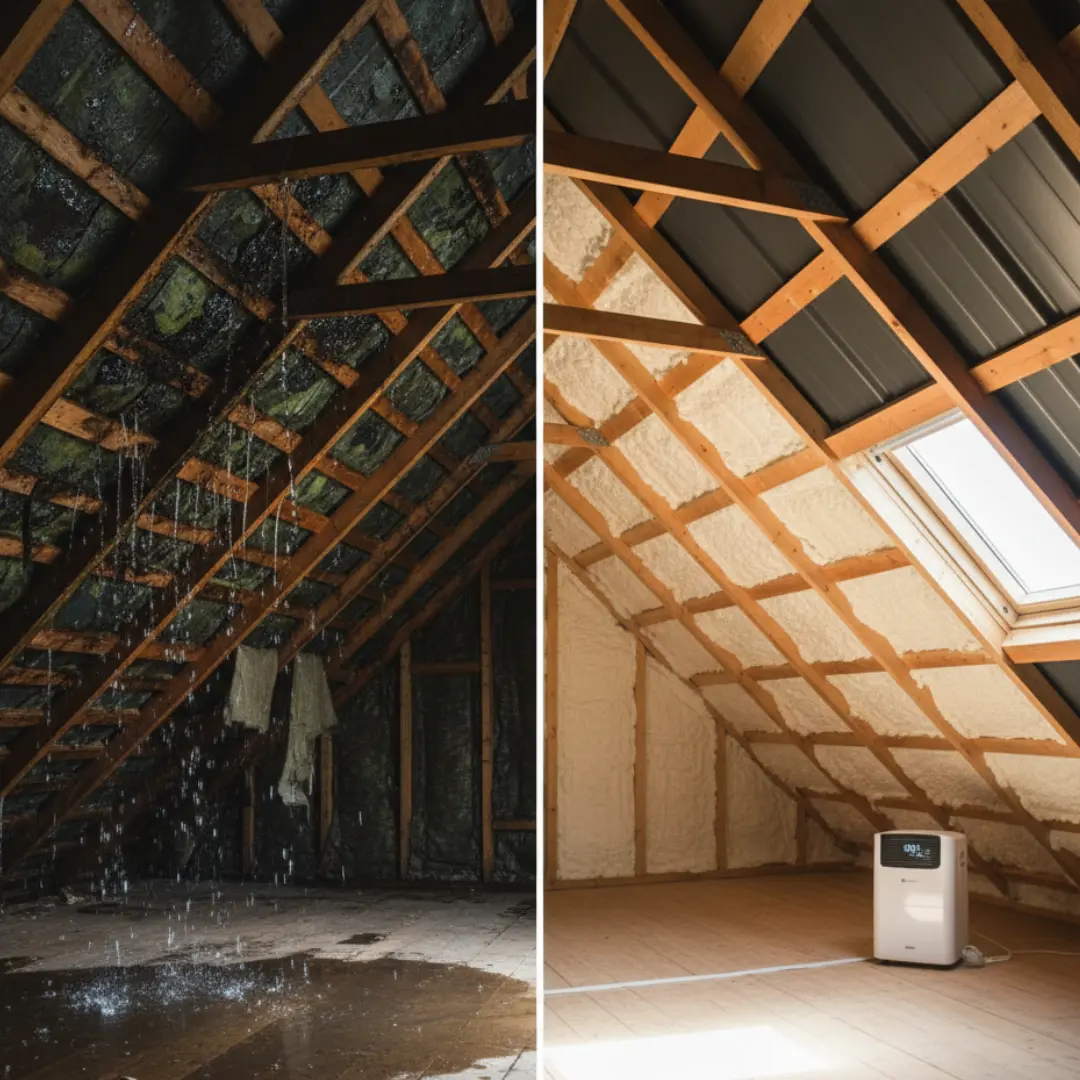
New roof replacement prevents mold and moisture in winter by installing waterproof underlayments blocking 99% of water infiltration, proper ventilation systems removing 400-600 cubic feet per minute of humid air from attics, sealed flashing eliminating penetration points allowing water intrusion, and modern materials resisting condensation formation during Florida's 60-70% winter humidity levels according to ASHRAE ventilation standards.

New roof replacement prevents mold and moisture in winter by installing waterproof underlayments blocking 99% of water infiltration, proper ventilation systems removing 400-600 cubic feet per minute of humid air from attics, sealed flashing eliminating penetration points allowing water intrusion, and modern materials resisting condensation formation during Florida's 60-70% winter humidity levels according to ASHRAE ventilation standards. Older roofs exceeding 15-20 years experience shingle deterioration, seal failures, and inadequate ventilation allowing moisture accumulation causing $3,000-15,000 in mold remediation costs and $8,000-25,000 in structural repairs according to FEMA flood damage assessments. South Florida homes installing new roofs during December-February prevent winter moisture problems while avoiding summer installation delays and preparing for hurricane season beginning June 1st.
Florida's winter months from December through February bring unique moisture challenges as overnight temperatures drop to 45-65 degrees while daytime humidity maintains 60-80% levels. These conditions create condensation when warm humid air contacts cooler roof surfaces and attic spaces. Understanding moisture infiltration mechanisms, proper ventilation requirements, material selection strategies, and installation timing helps homeowners prevent costly mold damage and structural deterioration. This comprehensive guide explains how roof replacement in Miami addresses winter moisture issues and why December-February represents optimal installation timing for South Florida properties.
How Does Winter Condensation Damage Older Roofs?
Winter condensation damages older roofs when warm humid indoor air rising into attics contacts cooler roof decking and underlayment surfaces, forming water droplets that accumulate causing wood rot, mold growth, insulation deterioration, and structural damage. According to ASHRAE research, attic surfaces reach 10-20 degrees below ambient outdoor temperatures during clear winter nights when radiational cooling occurs, creating dew point conditions even when outdoor humidity measures only 60-70%. A 2,000 square foot attic generates 1-2 gallons daily condensation during peak winter conditions when inadequate ventilation prevents moisture removal, saturating insulation reducing R-values by 40-60% and promoting toxic black mold growth requiring professional remediation costing $3,000-8,000.
Temperature Differential Physics
Florida winter nights bring outdoor temperatures of 45-60 degrees while indoor temperatures maintain 68-75 degrees. This 15-25 degree differential creates thermal gradients driving warm indoor air upward through ceiling penetrations, recessed lighting fixtures, attic access hatches, and wall cavities into attic spaces. Rising air carries water vapor content of 0.015-0.020 pounds per pound of dry air at typical indoor humidity levels.
When this warm humid air contacts roof decking cooled to 50-55 degrees through radiational heat loss to night sky, moisture condenses at rates of 0.1-0.3 gallons per 1,000 cubic feet of air. A 2,000 square foot home with 8-foot ceilings contains approximately 16,000 cubic feet attic volume. Complete air exchange condensing at these rates produces 1.6-4.8 gallons water daily during extended cold periods. This moisture accumulation exceeds evaporation rates in poorly ventilated attics, leading to progressive saturation.
Older Roof Vulnerability Factors
Roofs exceeding 15-20 years experience multiple degradation factors increasing moisture vulnerability. Asphalt shingle granule loss exposes organic mat materials that absorb moisture rather than shedding water. Underlayment deterioration from UV exposure and thermal cycling creates tears and gaps allowing water migration to roof decking. Flashing separation from thermal expansion cycles opens penetration points at chimneys, vents, and skylights.
Inadequate attic ventilation in older homes built before current building code requirements restricts moisture removal capacity. Florida Building Code requires 1 square foot net free ventilation area per 150 square feet attic space. Homes built 1990s-2000s often provide only 1:300 ratios, reducing ventilation effectiveness by 50%. Combined with aging materials, these deficiencies create perfect conditions for winter moisture accumulation and mold development.
Mold Growth Progression Timeline
Mold spores require moisture, organic material, and temperatures above 40 degrees for germination and growth. Florida attics provide all three conditions when condensation occurs. Mold colonization begins within 24-48 hours of surface saturation according to EPA mold remediation guidelines. Visible growth appears within 7-14 days covering wood surfaces, insulation facing, and stored items with characteristic black, green, or white colonies.
Established mold colonies produce mycotoxins causing respiratory irritation, allergic reactions, and immune system suppression. Stachybotrys chartarum, commonly called black mold, produces particularly toxic compounds requiring professional remediation using containment barriers, HEPA filtration, and antimicrobial treatments. Remediation costs $3,000-15,000 depending on contamination extent and structural damage requiring wood replacement. Installing metal roofs in Fort Lauderdale with proper ventilation prevents condensation formation eliminating mold growth risks.
What Ventilation Systems Prevent Winter Moisture Accumulation?
Ventilation systems preventing winter moisture accumulation include continuous ridge vents providing 18-20 net free inches per linear foot of ridge, soffit vents supplying low-level air intake maintaining balanced airflow, powered attic fans moving 1,200-1,600 cubic feet per minute during peak humidity periods, and gable vents supplementing cross-ventilation in complex roof geometries. According to ASHRAE Standard 62.2, residential attics require minimum 1 cubic foot per minute ventilation per 50 square feet attic floor area maintaining relative humidity below 60% preventing condensation formation. Properly designed ventilation systems achieve 8-12 complete air exchanges hourly removing moisture-laden air before condensation occurs on cooler surfaces.
Ridge and Soffit Vent Integration
Ridge vents installed along entire roof peaks create high-level exhaust points where buoyant warm humid air naturally exits attic spaces. Continuous ridge vents provide 18-20 net free ventilation area per linear foot compared to 9-12 inches for traditional box vents spaced 8-10 feet apart. This continuous design prevents dead air pockets where moisture accumulates between discrete vent locations.
Soffit vents supply low-level intake air maintaining positive ventilation flow from eaves to ridge. Continuous perforated soffit panels provide 8-10 net free inches per linear foot ensuring adequate intake matching ridge vent capacity. Proper intake-to-exhaust ratios of 1:1 or 1.25:1 create balanced systems where air moves uniformly through attic spaces rather than short-circuiting between nearby vents. Blocked soffit vents from insulation contact or paint closure reduce intake capacity by 60-80%, rendering ridge vents ineffective.
Powered Ventilation Solutions
Solar-powered attic fans supplement passive ventilation during peak humidity conditions when natural convection proves insufficient for moisture control. Fans rated 1,200-1,600 CFM provide 4-6 air changes hourly in 2,000-2,500 square foot attics. Thermostatically controlled units activate when attic temperatures exceed 90-100 degrees or humidity exceeds 70%, operating only when needed rather than continuously.
Electric attic fans offer higher capacity of 1,600-2,400 CFM but consume 200-400 watts during operation. Operating costs of $15-30 monthly during summer peak periods decline to $5-10 monthly during winter when reduced runtime needs occur. Programmable humidistats optimize operation cycling fans based on actual moisture levels rather than temperature alone. Professional installations include dedicated electrical circuits and proper vent placement maximizing exhaust efficiency.
Gable and Turbine Vent Applications
Gable vents installed in opposing end walls provide cross-ventilation utilizing prevailing wind patterns. Wind-driven ventilation achieves 2-4 times greater air movement than thermal convection alone during breezy conditions common in South Florida coastal areas. Gable vents measuring 24x24 inches provide approximately 3-4 square feet net free area, requiring 4-6 vents total achieving 1:150 ventilation ratios on typical homes.
Turbine vents use wind energy rotating turbine blades creating negative pressure exhaust. Each 12-inch turbine provides ventilation equivalent to 3-4 square feet static vent area when wind speeds exceed 5 mph. Turbines work well on hip roofs lacking continuous ridge lines for ridge vent installation. However, turbines require annual lubrication and bearing replacement every 8-12 years maintaining operation. Homeowners installing shingle roof replacement in Naples should specify comprehensive ventilation packages preventing winter moisture accumulation.
What Underlayment Materials Prevent Water Infiltration?
Underlayment materials preventing water infiltration include synthetic products using polypropylene or polyethylene construction achieving 50-year service lives, self-adhering rubberized asphalt membranes creating waterproof seals at vulnerable areas, and breathable materials allowing vapor transmission while blocking liquid water passage. According to ASTM D226 and D4869 standards, quality underlayments withstand 180-240 PSF wind uplift forces, resist 55-75 pound puncture loads during installation, and maintain waterproofing during 6-12 hour water submersion testing. Proper underlayment installation under new roofing materials prevents 95-99% of water infiltration during wind-driven rain events delivering 8-12 inches precipitation hourly common during South Florida storms.
Synthetic Underlayment Advantages
Synthetic underlayments manufactured from woven or spun-bonded polypropylene provide superior performance compared to traditional felt products. Synthetic materials resist tearing during installation, maintain dimensional stability preventing wrinkles and buckles, and allow safe foot traffic during construction without damage. Service life expectations of 40-50 years match or exceed metal and tile roofing lifespans eliminating premature underlayment failure issues.
Water resistance properties achieve ASTM D779 hydrostatic pressure ratings of 40-60 inches compared to 12-18 inches for #30 felt paper. This enhanced water resistance prevents infiltration during roof valleys, low-slope areas, and complex intersections where water concentrates during heavy rainfall. Vapor permeability ratings of 5-20 perms allow moisture vapor transmission from attic spaces preventing condensation accumulation beneath underlayment while blocking liquid water passage.
Self-Adhering Membrane Applications
Self-adhering rubberized asphalt membranes create waterproof barriers at critical vulnerability points including eaves, valleys, roof-to-wall transitions, and penetration flashings. Membranes adhere directly to clean roof decking without mechanical fasteners eliminating penetration points creating potential leak paths. Rubberized asphalt formulations remain flexible at temperatures from -40 to 240 degrees maintaining seal integrity through extreme thermal cycling.
Ice and water shield membranes installed along eaves extending minimum 24 inches inside exterior wall lines prevent water infiltration from ice dams in northern climates and wind-driven rain in Florida applications. Valley installations extending 18 inches each side of valley centerlines prevent side-wash infiltration during heavy rainfall concentrating in these drainage channels. Installation at all roof penetrations including plumbing vents, exhaust fans, and chimneys creates secondary waterproofing layers if primary flashing seals fail.
Breathable vs Non-Breathable Selection
Breathable underlayments with 5-20 perm vapor transmission ratings allow moisture vapor escaping from attic spaces to pass through underlayment rather than condensing on cool underlayment undersides. This vapor transmission proves critical in Florida's humid climate where attic moisture sources include indoor air infiltration, HVAC equipment condensation, and stored item moisture release. Trapped moisture between roof decking and non-breathable underlayments causes wood rot and mold growth within insulated cathedral ceilings lacking ventilation pathways.
Non-breathable underlayments with 0.1-1 perm ratings create absolute vapor barriers appropriate for metal roofing installations where underlayment must prevent moisture transmission to roof panels preventing interior condensation drip issues. These low-perm materials also work well in fully-ventilated attics where moisture removal occurs through airflow rather than vapor transmission through roofing materials. Professional contractors select appropriate underlayment types based on specific roof assembly designs and ventilation strategies. Installing tile roofs in West Palm Beach requires breathable underlayments allowing vapor transmission through air spaces beneath concrete tiles.
When Is the Best Time to Replace Roofs in South Florida?
The best time to replace roofs in South Florida is December through March when temperatures range 65-78 degrees providing ideal working conditions, rainfall averages only 2-3 inches monthly minimizing weather delays, contractor availability increases 40-60% compared to peak season, and homeowners prepare properties before June 1st hurricane season begins. According to National Roofing Contractors Association recommendations, moderate temperatures optimize material handling and installation quality as extreme heat causes asphalt shingle over-activation and worker fatigue reducing installation precision. Winter installations complete before spring rain increases in April-May and summer afternoon thunderstorms occurring 40-60% of days June-September, ensuring dry working conditions throughout project durations.
Temperature and Material Handling Benefits
Asphalt shingle manufacturers specify installation temperatures between 40-85 degrees Fahrenheit for optimal seal activation and flexibility. South Florida winter temperatures of 65-78 degrees fall within ideal ranges allowing proper shingle adhesive bonding without excessive softening or brittleness issues. Shingles installed during 90-100 degree summer temperatures experience premature seal activation during storage and handling, reducing long-term adhesion effectiveness by 20-30%.
Metal roofing materials expand and contract with temperature variations requiring proper fastening techniques accommodating thermal movement. Installing during moderate temperatures allows fasteners positioning at neutral expansion points preventing stress concentration during extreme seasonal variations. Sealants and adhesives cure optimally in 60-80 degree ranges, achieving maximum bond strength and flexibility. Summer heat causes rapid curing creating brittle seals while excessive cold prevents proper curing leaving weak adhesion points.
Weather Pattern Advantages
South Florida receives 55-65 inches annual rainfall with 70-75% occurring May through October. Winter months December through March average only 2-3 inches monthly with 5-8 rain days versus 8-12 inches monthly with 15-20 rain days during summer. This dramatic rainfall reduction provides extended dry periods allowing multi-day roofing projects completing without weather interruptions.
Afternoon thunderstorms occurring 50-70% of summer days create daily installation delays as crews secure work sites and wait 1-3 hours for storms passing. These delays extend typical 3-5 day projects to 6-10 days increasing labor costs and homeowner disruption. Winter installations proceed continuously with minimal weather delays ensuring projects complete within estimated timeframes and budgets. Hurricane season officially runs June 1st through November 30th with peak activity August-October. Completing roof replacements by May 31st ensures maximum storm protection before heightened hurricane risks arrive.
Contractor Availability and Pricing
Roofing contractors experience 60-80% lower demand during December-March compared to May-October peak periods following hurricane activity and insurance claim surges. Reduced demand allows homeowners selecting preferred contractors and scheduling installations within 2-4 weeks versus 8-12 week waits during peak season. Contractors provide more thorough project attention with less time pressure rushing between multiple simultaneous jobs.
Material pricing remains stable during winter months versus 10-20% increases during April-June when demand surges and manufacturers struggle meeting order volumes. Labor costs similarly remain competitive with contractors offering 5-10% winter discounts maintaining crew employment during traditionally slower periods. Permit processing through Miami-Dade, Broward, and Palm Beach county building departments completes in 2-3 weeks during winter versus 4-6 weeks during peak season when application volumes overwhelm review staffs. Homeowners planning roof repairs in Doral during winter maximize value through optimal pricing and installation conditions.
What Insulation Upgrades Prevent Winter Moisture Issues?
Insulation upgrades preventing winter moisture issues include blown-in fiberglass or cellulose achieving R-38 to R-49 values meeting Florida Building Code requirements, spray foam insulation sealing air leakage paths preventing humid air infiltration, radiant barriers reflecting 95% of radiant heat reducing attic temperature extremes, and proper installation maintaining ventilation pathways allowing moisture removal. According to Department of Energy guidelines, attic insulation should achieve minimum R-30 values in South Florida Climate Zone 1 while maintaining 2-inch clearance from roof decking allowing continuous airflow preventing moisture accumulation. Upgrading insulation during roof replacement provides convenient access and ensures coordinated moisture control strategies addressing both water infiltration and vapor management.
Blown-In Insulation Applications
Blown-in fiberglass and cellulose insulation fill attic spaces completely covering irregular framing, wiring, and junction boxes without gaps or voids reducing thermal performance. Professional installers achieve uniform R-38 to R-49 coverage using calibrated blowing equipment ensuring consistent density throughout attic areas. Proper density of 1.5-2.0 pounds per cubic foot for fiberglass and 2.5-3.5 pounds for cellulose prevents settling and maintains R-values throughout 20-30 year service lives.
Vapor permeable blown insulation allows moisture transmission preventing condensation accumulation within insulation layers. Fiberglass provides approximately 100 perms vapor transmission while cellulose treated with borates achieves 50-80 perms, allowing attic moisture escaping through ventilation systems rather than condensing within insulation materials. Cost ranges $1.50-2.50 per square foot installed for R-38 coverage making blown insulation most economical upgrade option during roof replacement projects.
Spray Foam Sealing Benefits
Closed-cell spray foam insulation applied to roof decking undersides creates conditioned attic spaces eliminating moisture condensation issues by maintaining attic temperatures within 5-10 degrees of indoor conditions. Foam application at 2-3 inch thickness achieves R-12 to R-18 values while providing complete air sealing preventing humid air infiltration from living spaces. This air sealing proves particularly effective in older homes with numerous ceiling penetrations difficult to seal using traditional methods.
Spray foam costs $3-6 per square foot installed representing 2-3 times blown insulation expenses but delivering superior air sealing and moisture control benefits. Closed-cell foam remains vapor impermeable with less than 1 perm transmission creating absolute vapor barriers preventing moisture movement into attic spaces. This approach works well in South Florida eliminating traditional attic ventilation requirements by conditioning attic spaces as part of building thermal envelopes. However, building officials may require engineering calculations confirming structural adequacy supporting foam application to existing roof decking.
Radiant Barrier Integration
Radiant barriers using aluminum foil laminates installed beneath roof decking or over attic insulation reflect 95-97% of radiant heat transfer reducing attic temperatures by 20-30 degrees during summer peak conditions. Lower attic temperatures reduce condensation potential during winter by minimizing temperature differentials between attic air and roof surfaces. Radiant barriers cost $0.40-0.80 per square foot installed providing cost-effective temperature control supplementing traditional insulation.
Proper installation requires 1-2 inch air space adjacent to reflective surfaces allowing radiant heat reflection. Barriers installed directly against roof decking or insulation without air spaces lose 60-80% effectiveness through conductive heat transfer. Perforated radiant barriers allow limited vapor transmission preventing moisture accumulation concerns in traditionally ventilated attic spaces. Combining radiant barriers with R-38 blown insulation and proper ventilation creates comprehensive moisture and thermal control systems. Homeowners installing residential solar panels in Fort Myers benefit from radiant barriers reducing attic heat gain improving solar panel efficiency through cooler roof surface temperatures.
How Much Does Roof Replacement Cost to Prevent Moisture Damage?
Roof replacement costs to prevent moisture damage range from $8,000-15,000 for asphalt shingle installations, $18,000-35,000 for metal roofing systems, and $22,000-45,000 for concrete tile applications on typical 2,000 square foot South Florida homes including moisture-prevention features like synthetic underlayments, enhanced ventilation systems, and proper flashing details. According to Remodeling Magazine's Cost vs Value Report, roof replacements return 60-68% at resale while preventing $15,000-40,000 in moisture damage repairs including mold remediation, structural wood replacement, and insulation renewal. Homeowners achieve 12-18 year payback periods through avoided damage costs, insurance premium reductions of 10-25%, and energy savings of $300-600 annually from improved insulation and ventilation.
Material and Labor Cost Breakdown
Asphalt shingle installations cost $3.50-6.50 per square foot for materials including architectural shingles, synthetic underlayment, ridge vents, and flashing components. Labor costs add $2.50-4.50 per square foot for professional installation including old roof removal, decking repairs, and complete system installation. A 2,200 square foot roof area typical for 2,000 square foot home totals $13,200-24,200 for complete shingle replacement with moisture-prevention features.
Metal roofing materials cost $6-12 per square foot depending on metal type, gauge thickness, and coating quality. Installation labor adds $6-10 per square foot requiring specialized equipment and trained crews. Total project costs range $26,400-48,400 for comprehensive metal roof installations including enhanced underlayments, ventilation upgrades, and trim details. Premium materials and complex roof geometries increase costs 20-30% above baseline estimates.
Moisture Prevention Feature Costs
Synthetic underlayment adds $0.50-1.50 per square foot versus standard felt paper but provides superior water resistance and longevity preventing premature failures requiring roof removal for underlayment replacement. Self-adhering ice and water shield at eaves and valleys adds $2-4 per linear foot protecting most vulnerable leak points. These enhanced materials add $1,200-2,800 to total project costs but prevent thousands in future water damage repairs.
Ridge vent installation costs $8-15 per linear foot including materials and labor. A typical home with 40-50 linear feet ridge requires $320-750 for continuous ridge vent systems. Soffit vent upgrades improving intake airflow cost $3-6 per linear foot requiring $180-360 for typical 60-80 linear feet soffit areas. Powered attic fans add $400-800 installed providing supplemental ventilation during peak humidity conditions. Combined ventilation upgrades total $900-1,900 ensuring adequate moisture removal preventing winter condensation issues.
Long-Term Cost Avoidance Benefits
Mold remediation costs $3,000-15,000 depending on contamination extent and structural damage severity according to EPA remediation guidelines. Structural wood replacement including rafters, decking, and ceiling joists costs $8,000-25,000 for extensive damage requiring major reconstruction. Insurance deductibles of $2,500-10,000 for water damage claims apply before coverage activates, leaving homeowners responsible for substantial out-of-pocket expenses.
Proper roof replacement preventing these damages provides 60-85% return on investment through avoided repairs alone, excluding insurance savings and energy efficiency benefits. Comprehensive moisture prevention features add only 8-12% to total project costs but prevent catastrophic damage requiring 2-4 times greater repair expenditures. Professional contractors like ASP SuperHome with CGC1513274 licensing ensure proper installation maximizing moisture prevention effectiveness and long-term value.
Conclusion
New roof replacement prevents mold and moisture in winter by installing waterproof underlayments, proper ventilation systems removing humid air, sealed flashing eliminating water infiltration points, and modern materials resisting condensation formation during Florida's 60-70% winter humidity conditions. December-March represents optimal installation timing providing ideal working temperatures, minimal rainfall, increased contractor availability, and completion before June 1st hurricane season. Comprehensive moisture prevention features including synthetic underlayments, ridge and soffit ventilation, and enhanced insulation add only 8-12% to total project costs while preventing $15,000-40,000 in moisture damage repairs including mold remediation and structural wood replacement.
Contact ASP SuperHome at (786) 933-9815 to schedule your winter roof replacement consultation today. Our certified installers (CGC1513274) serve Miami, Fort Lauderdale, Naples, West Palm Beach, Doral, and Fort Myers with comprehensive roofing solutions including asphalt shingle, metal, and tile systems featuring moisture-prevention technologies. We provide synthetic underlayments, enhanced ventilation packages, manufacturer warranties spanning 20-50 years, flexible $0 down PACE financing, and over 19 years of South Florida installation experience protecting 10,000+ homes from moisture damage. Visit our Doral showroom at 3400 NW 114th Ave to discuss moisture prevention strategies, review material options, and receive detailed installation proposals customized for your specific property and climate protection needs.
Meet With a Project Manager
Your first conversation is with a Project Manager who takes the time to understand your goals, walk you through your options, and stays connected throughout your project — from the initial consultation through the final walkthrough.
.avif)
.avif)
.avif)
%201.avif)
Insights & Resources
Stay informed with expert tips on roofing materials, hurricane codes, repairs, and South Florida construction standards.


%201.avif)
%201%20(1).avif)
%201.svg)
%201%20(1)%20(1).png)
.png.png)
.png%20(1).png)
.png%20(2).png)
.avif)
.avif)


.png)
.svg)
.png)