


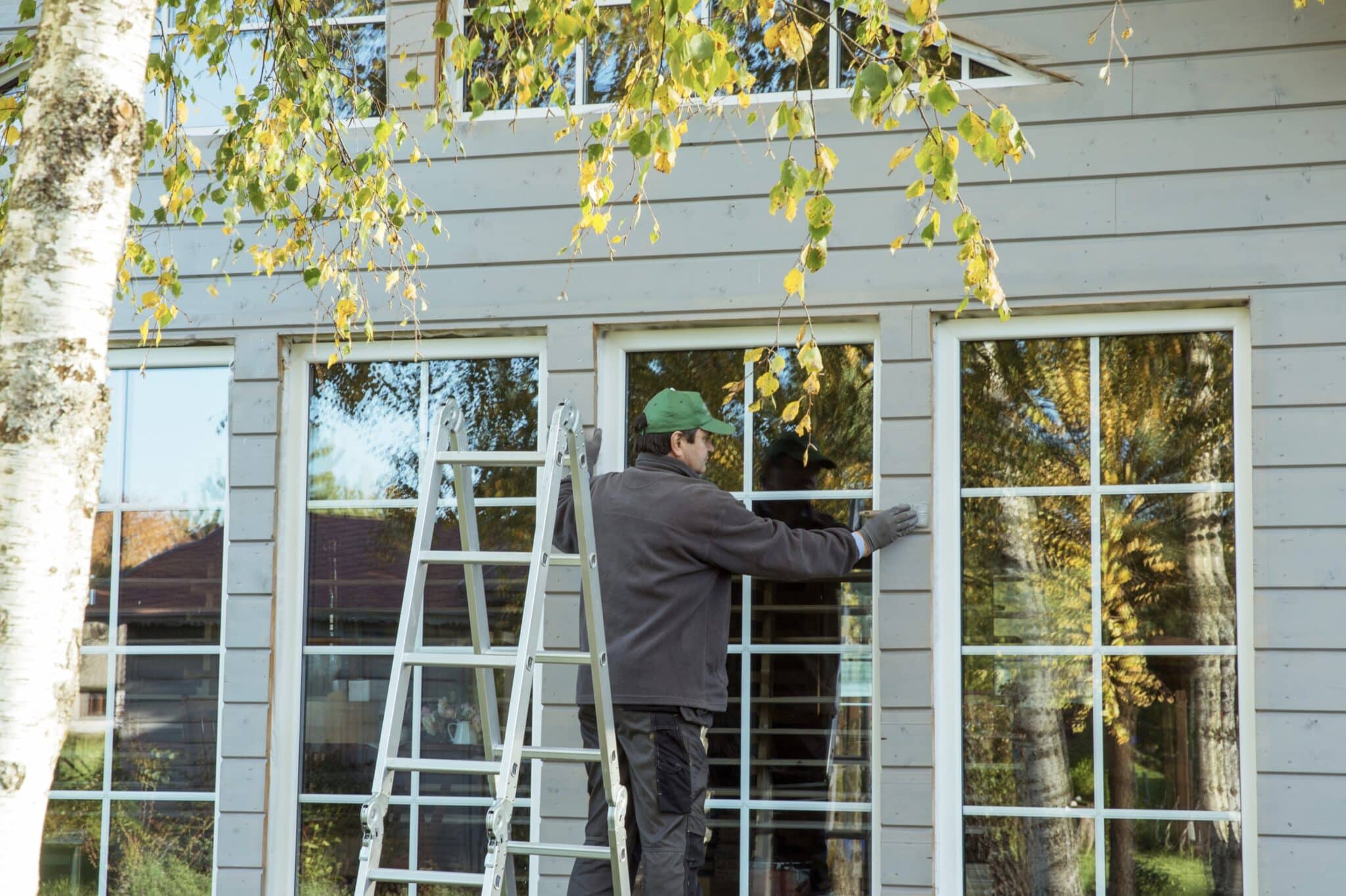

Six kinds of company install windows and doors: big-box home improvement retailers, manufacturer-branded showrooms and dealers, national franchise replacement companies, local licensed specialty contractors, general contractors and remodelers, and handymen. They all put glass in an opening, and they differ enormously on who holds the license, who employs the person on the ladder, who owns the labor warranty, and who answers the phone five years from now. Below we break down each type, explain what the job actually involves from trim to stucco, cover who pulls the permit in Florida and why that matters more here than almost anywhere else, and lay out the criteria that separate a company you can verify from one you are taking on faith.
Key Takeaways
- The six company types differ less on product than on accountability. The license holder, the crew's employer, and the warranty holder are sometimes three different parties.
- Florida requires a licensed contractor for window and door replacement. Unlicensed contracting is a first-degree misdemeanor on a first offense under Florida Statutes section 489.127.
- Contracts entered into by unlicensed contractors are unenforceable under section 489.128, which leaves the homeowner without recourse.
- Every window and door assembly installed in Miami-Dade or Broward needs a Miami-Dade Notice of Acceptance and testing under TAS 201, 202, and 203.
- Full-frame replacement and insert retrofit are different jobs with different scopes. Which one you get determines whether interior trim and exterior stucco are disturbed.
- Most residential impact window installations run one to three days, and yes, the crew needs interior access.
- Vinyl window replacement recoups roughly 67% to 72% of its cost at resale according to the 2025 Cost vs. Value Report.
- The license number, the permit responsibility, and the warranty split all belong in the written contract before you sign.
What Companies Do Window and Door Installation?
Six types of company do window and door installation: big-box home improvement retailers, manufacturer-branded showrooms, national franchise replacement companies, local licensed specialty contractors, general contractors, and handymen. Each type reaches the same finished opening through a different chain of responsibility.
Big-box home improvement retailers sell the product and arrange the labor. The installer who arrives is typically an independent contractor working under an agreement with the retailer rather than an employee of it, an arrangement the retailers describe in their own installation materials and document through published installer license listings by state.
Manufacturer-branded showrooms sit closer to the product. A window manufacturer operates or authorizes a local showroom, and installation is handled by factory-certified dealer crews trained on that manufacturer's line. Product knowledge runs deep and the catalog runs narrow, since the showroom sells one brand.
National franchise replacement companies operate on a locally owned, nationally branded model. The brand supplies the product line, the marketing, and the warranty framework, and the franchisee supplies the crews and the local licensing. Consistency depends on which franchisee holds your territory.
Local licensed specialty contractors carry their own license, employ their own crews, and answer for their own work. This is our category, and the reason we handle impact windows and doors with in-house teams rather than subcontractors is that accountability stops moving once the crew is on payroll.
General contractors and remodelers install windows as one piece of a larger project, which makes sense when the windows are part of a renovation and less sense when windows are the entire job. Handymen occupy the last category, and in Florida the licensing law treats that category very differently from the other five.
What Do You Call Someone That Installs Windows and Doors?
Someone who installs windows and doors is called a window installer, a window and door contractor, or a glazier, depending on the specific work they perform. The titles overlap in everyday use and mean different things in the trade.
A glazier works with the glass itself, cutting, fitting, and setting glass into frames, and the term traces back to the craft rather than to the contracting license. A window installer removes the existing assembly and sets the new one into the rough opening. A window and door contractor is the licensed entity that holds the contract, pulls the permit, and carries the insurance, which may or may not be the same person holding the drill.
Florida does not regulate what a company calls itself. Florida regulates what it is licensed to do. Titles on a truck door are marketing, and the license number is the fact underneath them, which is why the number rather than the title is the thing worth checking.
What Are the Different Types of Window and Door Companies?
The six types of window and door companies separate along four practical lines: who holds the license, who employs the installer, who holds the labor warranty, and who you contact years later when something needs attention. Product quality varies less between these categories than most homeowners expect. Accountability varies enormously.
Company Type
Who Holds the License
Who Employs the Installer
Who Holds the Labor Warranty
Who You Call in Year Five
Big-Box Retailer
The contracted installer, listed separately by state
An independent installation company
Retailer program terms, performed by the installer
The retailer's service line, which routes to whoever holds the contract then
Manufacturer Showroom
The showroom or its authorized dealer
Factory-certified dealer crews
Split between manufacturer and dealer
The local dealer, for that brand only
National Franchise
The local franchisee
The franchisee's crews
Brand framework, franchisee performance
The franchisee holding your territory at that time
Local Specialty Contractor
The company itself
Its own employees, where crews are in-house
The company itself
The same company that did the work
General Contractor
The general contractor
Usually a window subcontractor
The general contractor, backed by the sub
The general contractor, if still operating
Handyman or Unlicensed Installer
Nobody
Nobody, or the individual
No enforceable warranty
No reliable answer
Sources: Florida Statutes Chapter 489; Florida Department of Business and Professional Regulation licensing framework; published retailer installer license disclosures; manufacturer and franchise warranty documentation.
Business owners face the same set of categories with an additional wrinkle, since commercial openings carry different code requirements, different sizes, and different scheduling constraints than residential work. Companies that install commercial impact windows need storefront and mid-rise experience that does not automatically follow from residential volume.
Does a Handyman Install Windows?
A handyman can perform minor repairs, but replacing a window or door in Florida is contracting work that requires a licensed contractor. The line falls where the work touches the structure, the building envelope, or anything requiring a permit, which window and door replacement does.
Florida Statutes section 489.127 makes unlicensed contracting a criminal offense. A first offense is a first-degree misdemeanor carrying up to one year and a fine of up to $1,000. A second offense, or a first offense committed during a declared state of emergency, rises to a third-degree felony. That emergency provision exists specifically because unlicensed activity spikes after hurricanes, which is worth knowing in a market where storm damage drives a large share of window replacement.
The consequence that lands hardest on homeowners sits in section 489.128, which makes contracts entered into by unlicensed contractors unenforceable. Florida courts confirmed that principle in Earth Trades, Inc. v. T & G Corp. An unenforceable contract means there is nothing to sue on when the work fails.
Three further exposures follow from the same statutory chapter. The Florida Homeowners' Construction Recovery Fund, which exists to compensate consumers harmed by contractors, does not permit recovery where the contractor was unlicensed. Chapter 489's owner-builder disclosure warns that a property owner may be liable for injuries sustained by an unlicensed person working on the property, and that homeowner's insurance may not cover those injuries. And section 489.127 separately prohibits license lending, the practice of a licensed contractor pulling a permit on behalf of an unlicensed person, so the workaround is itself an offense.
None of this is an argument that handymen lack skill. It is an argument that the legal structure protecting you disappears when the work falls outside the license, and the same reasoning applies to homeowners considering the job themselves, a subject we cover in more detail on DIY installation risks.
Who Pulls the Permit for Window Replacement in Florida?
The licensed contractor pulls the permit for window replacement in Florida, and a company asking you to pull an owner-builder permit instead is shifting liability onto you. Permit responsibility is one of the cleanest tests of which company type you are actually dealing with, because pulling permits requires a license.
Requirements tighten sharply in the High-Velocity Hurricane Zone, which covers Miami-Dade and Broward counties. Under the Florida Building Code, Building, 8th Edition, ultimate design wind speeds reach 175 mph in Miami-Dade and 170 mph in Broward for Risk Category II construction. Every window and door assembly installed inside that zone must carry a Miami-Dade Notice of Acceptance covering the specific product.
A Notice of Acceptance certifies that the exact assembly passed testing under Testing Application Standards 201, 202, and 203. Large-missile testing under those standards launches a nine-pound two-by-four at 50 feet per second at the glass, and the assembly then faces 9,000 cycles of alternating positive and negative pressure. Cyclic pressure loading is what separates an approved assembly from one that merely survived a single hit, because hurricanes apply pressure for hours rather than instants.
The tolerance afterward is strict. An HVHZ assembly may show a tear no larger than five inches by one-sixteenth of an inch, against the five-inch by three-inch allowance permitted outside the zone under ASTM E1996. Products installed in Doral, and anywhere else inside the zone, have to meet the tighter number, and the approval document also dictates the anchor spacing and installation method rather than leaving those to crew preference.
Inspections close the sequence. Skipping the permit leaves an unpermitted alteration on the property that frequently surfaces during a future sale or insurance review, and installations that deviate from the approval document tend to fail inspection for reasons that were avoidable at the planning stage. We cover the recurring ones in our writeup on installation mistakes.
How Do You Choose the Best Window and Door Company?
You choose the best window and door company by verifying the license number, confirming who employs the crew, establishing who pulls the permit, and reading how the warranty splits between product and labor. Every item below is checkable before you sign, and each one distinguishes a company you can verify from one you are trusting.
- Get the license number on the proposal. A number, not a logo and not a claim. Ours is CGC1513274 and it appears on our paperwork.
- Ask who employs the installation crew. Employees and subcontractors produce different accountability when something needs correcting two years later.
- Confirm the contractor pulls the permit. Any request that you pull an owner-builder permit should end the conversation.
- Request the product approval numbers. Inside the High-Velocity Hurricane Zone, ask for the Notice of Acceptance covering the exact assembly being quoted.
- Separate the warranties. Product warranty, glass warranty, and labor warranty are three different terms, and the labor term is usually the shortest.
- Check insurance limits directly. Ask for the certificate from the carrier rather than a forwarded copy. We carry coverage above $2 million.
- Ask what happens to the opening. Whether interior trim comes off and whether exterior stucco gets cut should be answered before the deposit, not on install day.
- Get a written completion window. Custom-manufactured products carry lead times, and a vague answer at the quote stage stays vague later.
- Look for a physical location. A showroom you can walk into is harder to disappear than a phone number.
Homeowners comparing quotes on residential impact windows should hold every bidder to the same list, because the cheapest proposal is frequently the one that quietly omitted the permit, the approved product, or the labor warranty.
Warranty language rewards close reading more than any other section of a window contract. A long product warranty paired with a one-year labor term means the company that installed your windows stops being responsible for the installation long before the glass stops being covered. We publish our own warranty coverage instead of leaving it to the fine print, and any company should be willing to hand you theirs on request.
How Do You Verify a Contractor's License in Florida?
You verify a contractor's license in Florida by searching the license number through the Department of Business and Professional Regulation's public licensee database. The search returns the license status, the license type, the qualifying individual, and any disciplinary history attached to it.
Check three things while you are there. Confirm the license is active rather than expired or delinquent. Confirm the license type actually covers window and door work rather than a different trade. And confirm the name on the license matches the name on your proposal, since a license belonging to a different entity than the one contracting with you is a problem regardless of how the relationship is described. Selecting the right team is worth the fifteen minutes, and we walk through the broader evaluation in our piece on choosing a team.
What Gets Replaced When You Get New Windows?
What gets replaced depends on whether you receive a full-frame replacement or an insert retrofit, and the difference decides how much of the surrounding wall the crew disturbs. This is the largest scope variable in any window job and the one most quotes describe least clearly.
A full-frame replacement removes the entire existing assembly down to the rough opening, including the frame, the sill, and the anchoring. The crew then sets a new frame, anchors it to the structure, seals it, and rebuilds the finished surfaces around it. Full-frame is the standard approach for impact-rated work because the anchoring pattern specified in the product approval has to attach to the structure, not to an old frame of unknown condition.
An insert retrofit leaves the existing frame in place and fits a new window inside it. Less finish work is disturbed, the job moves faster, and the visible glass area shrinks slightly because the new unit sits inside the old frame. Insert retrofits suit sound frames and cannot deliver the structural anchoring that impact assemblies require.
Doors follow the same logic on a larger scale. Replacing impact doors almost always means full-frame work, since the threshold, the jamb, and the anchoring all carry load that an insert cannot transfer properly.
Do You Have to Remove Interior Trim When Replacing Windows?
You have to remove interior trim on a full-frame replacement, and usually not on an insert retrofit. Full-frame work requires access to the rough opening, and the casing and stool sit directly over it.
Trim that comes off carefully can often go back on, though older painted or caulked trim tends to split during removal and gets replaced instead. Ask before signing whether trim replacement and repainting are included in the quoted scope or billed separately, because that single line accounts for a surprising share of change orders. Sliding units and large openings involve more finish work than a single window, and sliding glass doors in particular carry substantial interior finish around the track and jamb.
Does the Exterior Stucco Have to Be Cut?
Exterior stucco usually has to be cut on a full-frame replacement, because the stucco laps over the existing frame flange and has to be opened to reach the anchors. Most residential construction across this region is concrete block with stucco rather than siding, so stucco work is the relevant exterior question here.
A competent crew cuts a clean line, replaces the assembly, and patches the stucco back to match. Patching is where quality shows, since a rushed patch telegraphs through paint and a proper one disappears. Confirm that stucco repair and paint touch-up are written into the scope rather than assumed, and confirm who is responsible for matching the existing texture. The same question applies at entry doors, where the surround and threshold both get disturbed.
Do Window Installers Have to Come Inside?
Window installers have to come inside, because every window is removed and set from both sides and the interior finish work happens indoors. There is no version of a window replacement that happens entirely from a ladder outside.
Interior access means practical preparation on your side. Clear a working path of roughly three to four feet in front of each opening, take down blinds, curtains, and rods, remove wall hangings near the openings, and move furniture back from the windows. Crews normally set drop cloths and protect flooring, though confirming that is part of the scope beats assuming it.
Dust and noise come with the work, and both are heaviest during removal. Households with pets, infants, or anyone working from home tend to have a better week if the crew's daily sequence is discussed in advance, since installations run room by room rather than all at once.
How Long Does a Window Install Take?
A typical residential impact window installation takes one to three days on site, though the full project from contract to final inspection runs considerably longer. The on-site portion is the short part of the timeline and the part homeowners tend to focus on.
Individual openings move faster than people expect. A standard window runs roughly 30 to 60 minutes for a straightforward insert retrofit and longer for full-frame work with stucco cutting and patching. Large sliding units, arched openings, and doors take substantially more time per unit.
A typical installation day follows this sequence:
- Walkthrough and protection. The crew confirms the opening list, sets drop cloths, and protects flooring and furnishings.
- Removal. The existing assembly comes out, one opening at a time, so the house is never broadly open.
- Opening preparation. The rough opening is cleaned, inspected for damage, and squared as needed before anything new goes in.
- Setting and anchoring. The new unit is set, shimmed level and plumb, and anchored to the pattern the product approval specifies.
- Sealing and waterproofing. Flashing and sealant go in to keep water out, which is the step that quietly determines whether the installation lasts.
- Interior and exterior finish. Trim goes back, stucco gets patched, and caulk lines are tooled.
- Operation check and cleanup. Every unit is opened, closed, locked, and unlocked before the crew leaves, and debris goes with them.
Permitting and manufacturing sit outside those days and drive the calendar. Impact-rated products are built to the measurements of your specific openings, so nothing ships from a shelf, and permit review timelines vary by municipality. Scheduling realities are worth understanding early, and we break them down further in our overview of scheduling and duration.
How Long Does It Take to Replace 20 Windows in a House?
Replacing 20 windows in a house takes roughly two to four days of on-site work for most homes, depending on the replacement method and the size of the openings. Crew size drives the number as much as window count does, since a larger crew works multiple openings in parallel.
Full-frame replacement with stucco cutting on 20 openings sits at the longer end of that range. Insert retrofits on standard-size openings sit at the shorter end. Second-story openings, arched or custom shapes, and any opening requiring structural repair add time that a per-window average does not capture.
What Is the Cheapest Time of Year to Replace Windows?
The least competitive time to replace windows in this region is the winter and early spring stretch, roughly December through April, when demand drops between hurricane seasons. Availability rather than seasonal discounting is what shifts, and availability is worth more than most homeowners realize.
Demand here follows storm risk rather than temperature. Inquiries surge from June onward as hurricane season builds, spike again after any named storm, and stay elevated through the fall. During those stretches, lead times stretch, permit offices back up, and the best crews book out weeks ahead.
Scheduling in the off-peak window buys three things: shorter manufacturing lead times, faster permit review, and a completed installation already in place before the next season starts. Waiting until a storm is named is the most expensive timing choice available, because that is when both the calendar and the labor pool are tightest.
Should 20 Year Old Windows Be Replaced?
Twenty-year-old windows should generally be replaced in this market, because they predate current code requirements and have usually lost their seals and hardware performance. Age alone is not the argument. What changed around them is.
Code moved substantially over that period, and windows installed two decades ago frequently do not meet the wind-borne debris and pressure requirements that apply today. Closing that gap is the main reason homeowners move to impact-rated products when the old units come out. The gap matters at insurance renewal as much as in a storm, and many insurers offer discounts of 15% to 45% for hurricane-rated impact windows and doors.
Physical signs are easier to read than dates. Fogging or condensation between panes means the insulated glass seal has failed. Difficulty opening, latching, or locking points to hardware and frame wear. Visible daylight, drafts, or water intrusion at the perimeter indicates the seal to the structure has gone. Any one of those is a functional reason to act regardless of the number on the calendar.
The financial case is real without being a windfall. Vinyl window replacement recoups roughly 67% to 72% of its cost at resale according to the 2025 Cost vs. Value Report, and eight of the ten highest-return projects in that report were exterior replacements. ENERGY STAR certified windows reduce heating and cooling costs by about 12% on average nationally, and the offset runs higher in a cooling-dominated climate.
What Should Be in a Window Installation Contract?
A window installation contract should name the license number, define the replacement method, list the product approval numbers, assign permit responsibility, and separate the product warranty from the labor warranty. Everything this article recommends verifying should end up in writing, because a verbal answer at the kitchen table is not a term.
Scope deserves the most attention. The document should state the count and location of every opening, specify full-frame or insert retrofit, and say explicitly whether interior trim replacement, stucco patching, and paint touch-up are included. Ambiguity in that paragraph is where change orders come from.
The rest is a checklist. License number and qualifying entity name. Manufacturer, product line, and Notice of Acceptance numbers for the exact assemblies. Which party pulls the permit and schedules inspections. A completion window with the manufacturing lead time acknowledged. Payment schedule tied to milestones rather than dates. Product, glass, and labor warranty terms stated separately. Homeowners across South Florida who get those items on paper before signing rarely need any of the remedies discussed earlier, and choosing window and door installation from a company willing to commit them to writing is most of the decision.
Frequently Asked Questions
Who Is Responsible if a Window Is Installed Wrong?
The licensed contractor who holds the installation agreement is responsible if a window is installed wrong, even where a subcontractor performed the work. Responsibility follows the contract rather than the ladder. This is why the arrangement between the seller and the installer matters at the quoting stage, since a retailer program, a franchisee, and a direct contractor route a warranty claim through different numbers of parties.
Can You Install Impact Windows Yourself?
You cannot properly install impact windows yourself in most Florida jurisdictions, because the work requires a permit and permits require a licensed contractor. The technical obstacle is as real as the legal one: the Notice of Acceptance specifies the anchor type, spacing, and embedment for the assembly, and an installation that deviates from it loses both its approval and its rated performance.
What Is a Notice of Acceptance for Windows?
A Notice of Acceptance is a Miami-Dade County product approval certifying that a specific window or door assembly passed the required impact, pressure, and water infiltration testing. It covers the exact configuration rather than the product family, and it prescribes the installation details the crew must follow. Assemblies without a current Notice of Acceptance cannot legally be installed in the High-Velocity Hurricane Zone.
Does Replacing Windows Require an Inspection in Florida?
Replacing windows requires an inspection in Florida wherever a permit was required, which covers essentially all replacement work. The building department verifies the approved product, the anchoring, and the installation against the permit documents. An inspection that never happens leaves the permit open, and open permits regularly surface during a later sale or insurance review.
What Warranty Should a Window Installer Provide?
A window installer should provide a labor and workmanship warranty separate from the manufacturer's product warranty, stated in writing with its own term. Product warranties commonly run long while labor terms run much shorter, and the installation is what fails first in most water intrusion cases. Ask for both documents before signing rather than after.
What Is a Glazier?
A glazier is a tradesperson who cuts, fits, and installs glass into frames, windows, doors, and storefronts. The term describes the craft rather than the contracting license, so a glazier may work as an employee of a licensed company rather than holding a contractor license personally. On commercial storefront and curtain wall work, glazing is a specialty in its own right.
The Takeaway
Six kinds of company install windows and doors, and the meaningful difference between them is not the glass. It is whether the license, the crew, and the warranty sit with the same organization, and whether that organization will still be reachable when a seal needs attention in year seven. A big-box program, a manufacturer showroom, a franchise, a general contractor, a local specialty contractor, and a handyman all produce a finished opening, and they produce very different answers to the question of who is accountable for it.
Four things settle the choice before you sign: the license number verified through the state database, a clear answer on who employs the crew, written confirmation that the contractor pulls the permit, and a warranty that separates product from labor. Add the product approval numbers if you are anywhere inside the High-Velocity Hurricane Zone. If you would like a straight walkthrough of your openings and a written scope you can compare against anyone else's, the team at ASP SuperHome is glad to help anywhere across South Florida.
Meet With a Project Manager
Your first conversation is with a Project Manager who takes the time to understand your goals, walk you through your options, and stays connected throughout your project — from the initial consultation through the final walkthrough.
.avif)
.avif)
.avif)
%201.avif)
Insights & Resources
Stay informed with expert tips on roofing materials, hurricane codes, repairs, and South Florida construction standards.



%201.avif)
%201%20(1).avif)


%201.svg)
%201%20(1)%20(1).png)
.png.png)
.png%20(1).png)
.png%20(2).png)
.avif)
.avif)


.png)
.svg)
.png)