


Solar Panel Installation Cost


Solar panel installation costs between $18,000 and $30,000 on average for a typical home before incentives, or roughly $2.20 to $3.50 per watt installed. The final number depends on your system size, roof type, location, and equipment choices. Florida homeowners, in particular, often fall on the lower end of that range because the Sunshine State offers more solar production hours per day than most of the country. This guide covers everything you need to know about solar panel installation costs, from the factors that drive the price to how long it takes to earn your money back.
What Is the Average Cost of Solar Panel Installation?
The average cost of solar panel installation in the United States is around $2.50 to $3.50 per watt before incentives, according to the National Renewable Energy Laboratory (NREL) and the Solar Energy Industries Association (SEIA). For a typical 7 to 10 kW system, that puts most homeowners in the $18,000 to $35,000 range before any savings programs are applied.
In Florida, the numbers look a bit friendlier. According to EnergySage marketplace data, the average solar installation in Florida runs about $2.20 per watt installed, putting a standard 8 to 10 kW system somewhere between $18,000 and $28,000 before incentives. Florida averages 5.5 to 6.0 peak sun hours per day, among the best in the nation, which means your panels produce more power per dollar spent compared to cloudier states.
It is also worth knowing what is actually included in that price. According to the U.S. Department of Energy, the panels themselves account for only about 12% of the total installation cost. The rest of your budget goes toward inverters, mounting hardware, wiring, labor, permits, and overhead from the installer. That is why two quotes for the same panel brand can differ by thousands of dollars.
How Much Is Solar Panel Installation Per Watt?
Solar panel installation costs per watt range from $2.20 to $3.50 in most U.S. markets as of 2026. Florida sits on the lower end at around $2.20 to $2.80 per watt installed, thanks to a competitive installer market and strong year-round sun. A smaller 5 kW system for an average-sized home runs roughly $11,000 to $15,000 before incentives, while a larger 12 kW system for a high-usage household can climb to $26,000 to $35,000. The cost per watt typically drops slightly as system size goes up, similar to buying in bulk.
How Much Does Solar Cost for a 2,000 Sq Ft House?
Solar for a 2,000 square foot house typically costs between $18,000 and $28,000 before incentives, based on an average system size of 7 to 9 kW needed to offset typical energy usage for that home size. However, square footage is less important than actual kilowatt-hour consumption. A 2,000 sq ft home that runs central air all year in South Florida will need a larger system than an equally sized home in a milder climate. Checking your 12-month electricity bills for total kWh usage is the most reliable way to size your system correctly.
The solar energy systems we install are sized to match your actual energy footprint, not just your square footage. That matters because an oversized system just generates credits at wholesale rates, while an undersized one still leaves you with a utility bill.
What Factors Affect Solar Panel Installation Cost?
The factors that affect solar panel installation cost are system size, panel type, roof characteristics, location, battery storage, and the installer you choose. Each one can shift your total cost by thousands of dollars in either direction, which is why two homes on the same street can receive very different quotes.
System Size and Energy Usage
System size is the single biggest driver of your total cost. The more electricity your household uses, the larger the system you need. According to the U.S. Energy Information Administration, the average American home uses about 10,791 kWh of electricity per year. Florida homes tend to use more because of year-round air conditioning. EnergySage data shows the average Florida homeowner needs a 9 to 14 kW system to offset most of their bill. Larger systems cost more upfront, but they typically offer a lower cost per watt and better long-term value.
Type of Solar Panels
Panel type matters both for cost and performance. The three main types used in residential systems are monocrystalline, polycrystalline, and thin-film. Monocrystalline panels are the most common choice for homes. They offer the highest efficiency at 15% to 22% and the longest lifespan, but they cost more per panel. Polycrystalline panels are slightly less efficient and less expensive. Thin-film panels are the cheapest but also the least efficient, meaning you need more roof space to generate the same amount of power.
For most Florida homeowners, monocrystalline panels from brands like Q Cells, Trina, or REC offer a strong balance of price, efficiency, and durability. With Florida's abundant sunshine, you do not always need the most expensive premium panels to hit your savings goals.
Roof Type, Pitch, and Condition
Your roof directly affects installation labor costs. Standard asphalt shingle roofs are the easiest and least expensive surface to work on. Tile and metal roofs require specialized mounting hardware and more labor time, which can add to the cost. A steep pitch or complex roof with multiple angles and dormers also takes longer to work on. According to This Old House, roof complexity can add several hundred to a few thousand dollars to your quote. If your roof is near the end of its life, it is smart to replace it before adding panels, since removing and reinstalling the solar system later adds cost.
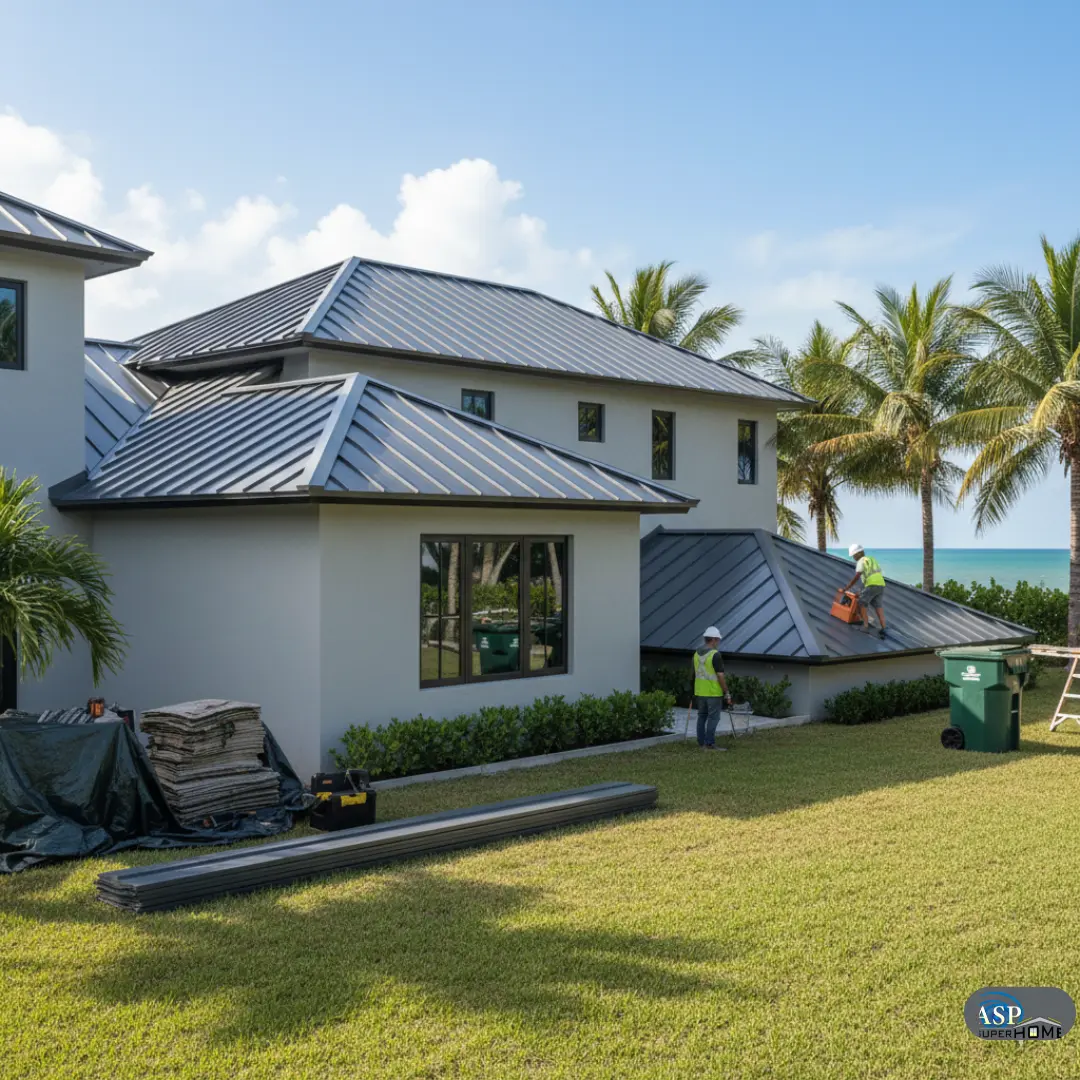
Many homeowners pair their solar installation with a new roofing project to handle both upgrades at once. A standing seam metal roof, for example, is one of the best surfaces for solar mounting and lasts 40 to 70 years, giving your panels a sturdy platform for their entire useful life.
Location and Local Incentives
Where you live affects both your installation cost and your savings potential. Labor rates, permitting fees, and local utility policies all vary by city and county. Florida is generally a lower-cost market for solar installation compared to the national average, partly because strong installer competition keeps prices reasonable. Your location also determines how much electricity your panels produce each year. More production means faster payback.
Battery Storage Add-Ons
Adding a solar battery backup system increases your upfront cost but gives you power during outages. According to NRG Clean Power, a typical solar battery installation costs between $9,000 and $18,000 before incentives. In South Florida, where hurricanes and tropical storms can knock out the grid for days, a solar battery backup system is more than a convenience. It is peace of mind. Lithium batteries like the Tesla Powerwall are the most popular option, with a 10 to 15 year lifespan.
Solar Panel Cost by System Size
System SizeGross Cost (Before Incentives)Typical Home SizeEst. Annual Production (FL)5 kW$11,000 – $15,500Small home / low usage~7,500 kWh/year7 kW$15,400 – $21,000Average home~10,500 kWh/year9 kW$19,800 – $27,000Large home / moderate A/C use~13,500 kWh/year12 kW$26,400 – $36,000Large home / heavy A/C use~18,000 kWh/year15 kW$33,000 – $45,000Very large home / high usage~22,500 kWh/year
Sources: EnergySage Marketplace Data (2025–2026), NREL PVWatts Calculator, SolarReviews Florida Cost Guide (2025), IntegrateSun Solar Pricing Report (2025). Florida production estimates assume 5.5 peak sun hours per day and standard south-facing roof orientation.
What Are the Incentives for Solar Panel Installation?
The incentives for solar panel installation in Florida include state property tax exemptions, a sales tax exemption on solar equipment, and the possibility of third-party financing arrangements that may pass along commercial tax credits. The federal 30% Residential Clean Energy Credit (Section 25D) expired on December 31, 2025 per the One Big Beautiful Bill Act, signed into law on July 4, 2025. If you purchased and installed your system before that date, you are still eligible to claim the credit on your return. For new cash or loan purchases in 2026, the federal residential credit is no longer available.
Florida-Specific Solar Incentives Still in Play
Florida still offers two valuable state-level incentives. First, under Florida Statute 193.624, solar energy systems are exempt from property tax assessments. This means your home value goes up when you add solar, but your property taxes do not. Second, solar equipment is exempt from Florida's state sales tax, which saves you 6% or more on the cost of the system itself. These two exemptions together can reduce your net cost by several thousand dollars depending on system size.
Net metering is also still available in Florida for most homeowners with the state's major utility providers. Under net metering, any excess electricity your panels send to the grid earns you credits against future bills. However, Florida's net metering credit rates are gradually decreasing. Credits moved from 75% of the retail rate in 2024 through 2025, dropping to 60% in 2026 and 50% in subsequent years, according to ConsumerAffairs. This makes sizing your system accurately more important now than ever, since sending large amounts of excess power to the grid at a reduced rate lowers your overall savings.
For homeowners who want $0 down and flexible monthly payments, we offer PACE financing through programs like Ygrene and Renew Financial, as well as traditional financing options through trusted partners. Many homeowners find that their monthly loan payment is lower than what they were previously paying on their electric bill, creating savings from day one.
Does Solar Really Lower Your Electric Bill?
Yes, solar really does lower your electric bill, often significantly. According to the U.S. Energy Information Administration, the average American household spends about $1,942 per year on electricity. A properly sized solar system can reduce or eliminate most of that cost. EnergySage data shows that most homeowners who go solar save between $37,000 and $154,000 over 25 years, depending on their location, usage, and electricity rates.
In Florida, the average homeowner with solar can expect to save around $51,910 to $52,610 over 25 years, based on ConsumerAffairs and EnergySage data. That works out to roughly $170 to $210 per month in reduced utility costs. Keep in mind that even with a well-sized system, most grid-tied homeowners still receive a small monthly utility bill that covers base service charges and fees, typically around $15 to $30 per month. Completely eliminating the bill requires either an oversized system with battery storage or going fully off-grid.
The Bureau of Labor Statistics shows that the price of grid electricity has increased in 31 of the last 40 years, averaging about 2.79% annually over the past two decades. In 2022 alone, electricity prices spiked 12.6% nationwide. Every year your solar panels are running, they protect you from those increases by generating free electricity from your roof.
We also pair residential solar panels with impact window installations for homeowners who want to reduce their energy load before sizing their solar system. Lowering the amount of heat entering your home through your windows means a smaller solar system can cover a larger percentage of your bill, improving your return on investment.
What Is the Payback Period for Solar Panels?
The payback period for solar panels is typically 6 to 12 years for most U.S. homeowners, according to Tesla Energy and NREL. In Florida, EnergySage data shows an average payback period of about 5 years for well-sized systems, which is one of the best in the country. After the payback period, every kilowatt-hour your panels generate is essentially free electricity. A system with a 6-year payback period on a 25-year lifespan gives you 19 years of free power.
Payback periods are shorter in Florida because the state has above-average electricity rates, exceptional sunlight (5.5 to 6.0 peak sun hours daily), and lower installation costs than many other markets. If you add in insurance premium reductions for homes with both solar and impact windows and doors, the total payback calculation gets even better. Insurance discounts for hurricane-rated upgrades commonly run 10% to 45% on windstorm premiums, compounding the annual savings.
How Do You Calculate the Break-Even Point for Solar Panels?
You calculate the break-even point for solar panels by dividing your total net system cost (after incentives and savings) by your total annual savings from reduced electricity bills. For example, if your system costs $22,000 after all available incentives and your electricity savings are $2,200 per year, your break-even point is 10 years. This is a simplified payback calculation. A more complete picture factors in the annual rate of electricity price increases, which have historically averaged about 2.79% per year according to the Bureau of Labor Statistics, and the 0.5% to 0.8% annual degradation rate of your panels over time.
How Long Do Solar Panels Typically Last?
Solar panels typically last 25 to 30 years, with many systems continuing to produce electricity well beyond that period at reduced efficiency. A Berkeley Lab survey of U.S. solar industry professionals found that the average operational lifespan has increased from about 20 years in 2007 to 25 to 35 years in 2025. Most manufacturers provide a performance warranty guaranteeing at least 80% of rated output for 25 years.
Panels degrade gradually over time rather than failing all at once. The National Renewable Energy Laboratory reports an average degradation rate of 0.5% to 0.8% per year. Premium monocrystalline panels from top-tier manufacturers can achieve degradation rates as low as 0.25% to 0.3% per year, meaning a system installed today could still be operating at 93% or more of its original output by 2050. The U.S. EPA confirms that crystalline silicon panels, which make up over 95% of panels sold today, are expected to last 25 years or longer. Inverters typically need replacement after 10 to 15 years at a cost of $1,500 to $3,000, which is the most common maintenance expense over a system's life.
What Happens After 25 Years of Solar?
After 25 years of solar, your panels do not simply stop working. They continue to produce electricity but at a reduced efficiency. Most panels will still generate 80% to 82% of their original rated output after 25 years, based on the standard 0.8% annual degradation rate. For most homeowners, the practical decision at that point is whether to replace the aging system with a newer, more efficient model, or continue running the existing panels until output drops to a level that no longer justifies keeping them. Many homeowners choose to replace panels around the 30-year mark, benefiting from the continued technological improvements in efficiency and cost that have reduced solar prices by more than 85% since 2014 according to the Office of Solar Energy Efficiency and Renewable Energy.
Does Solar Increase Home Value?
Yes, solar increases home value for owned systems. A 2025 study by SolarReviews analyzing over 400 homes found that homes with owned solar panels sold for an average of 6.9% more than comparable homes without solar. For a median-valued home at around $416,900, that translates to nearly $29,000 in added value. The Lawrence Berkeley National Laboratory has separately confirmed that buyers consistently pay a premium of approximately $4 per installed watt for homes with solar. Research from Rocket Homes shows that solar homes are on the market 13.3% less time and are 24.7% more likely to sell above asking price compared to non-solar homes.
Two important caveats apply. First, the value increase applies to owned systems. Leased systems or power purchase agreements do not consistently boost home value and can sometimes complicate a sale because buyers have to take over the contract. Second, Florida specifically offers a property tax exemption for solar installations under state statute, so your property taxes do not increase even as your home value rises. That makes the value increase a pure benefit with no offset on the tax side.
Can a House Run 100% on Solar?
Yes, a house can run 100% on solar, but doing so typically requires both a properly sized panel array and a battery storage system to cover power needs at night and during cloudy periods. For most grid-tied Florida homeowners, a system designed to offset 95% to 100% of annual kWh usage paired with net metering effectively eliminates the electricity portion of the utility bill. The utility base service charges, usually $15 to $30 per month, remain. Homes that want true independence from the grid during hurricane season and power outages benefit most from adding a solar battery backup, which stores excess daytime generation for use at night or during outages.
Why Is My Bill Still High If I Have Solar?
Your bill may still be high with solar if your system is undersized for your actual energy use, if your energy consumption has increased since installation, if your panels are underperforming due to shading or soiling, or if your utility has fixed charges that appear regardless of how much solar you generate. The first step is to check your monitoring app or inverter data to verify your system is producing what it should. A well-functioning system sized to 100% of your usage should reduce most of your variable electricity charges to near zero. If you see a gap between expected and actual production, a solar panel repair or inspection may be needed to restore full performance.
What Maintenance Do Solar Panels Need?
Solar panels need minimal maintenance, but some basic upkeep extends their lifespan and protects your investment. Cleaning panels twice a year removes pollen, dust, and salt residue that can reduce output by 5% to 15% if left to accumulate. In South Florida's coastal environment, salt air buildup is a real factor. Rinsing panels with fresh water and a soft brush is all most homeowners need. Professional cleaning services typically cost $100 to $200 per visit for a standard residential array. Beyond cleaning, annual visual inspections to check for cracked glass, loose mounts, or corroded connections are worthwhile, especially after major storms. Your inverter performance should also be monitored through your system's app. Most problems flagged early cost $200 to $500 to fix. Catching them late can mean $2,000 to $5,000 in component replacements.
We also offer ongoing solar panel repair services for homeowners throughout South Florida who need system inspections, output testing, or component replacement to keep their systems running at peak capacity.
Commercial Solar Panel Installation Cost
Commercial solar panel installation costs less per watt than residential because the systems are larger, spreading the fixed overhead costs across more capacity. According to SolarReviews, the average cost for commercial solar in 2025 is approximately $2.00 per watt before incentives. A small retail or office building needing a 50 kW system might expect a gross cost of $100,000, while a larger warehouse installation of 250 kW could run $500,000 or more, both before applicable incentives. Commercial solar systems qualify for different incentives than residential, including the Section 48E commercial investment tax credit, which remains active for systems where construction begins before July 2026.
We install commercial solar panels for businesses, warehouses, retail spaces, and multi-unit buildings throughout South Florida. Every commercial system is engineered to meet Florida's structural, climatic, and permitting requirements while maximizing long-term ROI for the property owner.
Frequently Asked Questions
How Much Is a Solar System for a 2,000 Sq Ft House?
A solar system for a 2,000 sq ft house typically costs between $18,000 and $28,000 before incentives in Florida, based on an average system size of 7 to 9 kW needed to offset most of that home's electricity use. The actual cost depends more on how much electricity the home uses than on its square footage. A home with a pool, electric water heater, and central A/C running year-round will need a larger system than a 2,000 sq ft home with more moderate energy habits.
What Wears Out on a Solar Panel?
The parts that wear out on a solar panel over time are the encapsulant material that protects the solar cells, the backsheet, and the junction box connections. These components degrade gradually through UV exposure, heat cycling, and moisture, causing the slight output reduction of 0.5% to 0.8% per year that is standard for most residential panels. The solar cells themselves are extremely durable with no moving parts, but cracked glass from hail or debris impact is the most common type of physical damage. Inverters are the component most likely to need full replacement during a system's life, typically around the 10 to 15 year mark.
Do Homes with Solar Sell Faster Than Homes Without?
Yes, homes with solar sell faster than homes without solar in most markets. Data from Rocket Homes shows that solar homes spend 13.3% less time on the market and are 24.7% more likely to sell above asking price than comparable non-solar homes. A 2025 SolarReviews study found that owned solar systems add an average of 6.9% to home sale prices nationally. The value boost is strongest when the system is owned outright, properly maintained, and located in a market with meaningful electricity costs like Florida.
Can You Have a Power Outage with Solar?
Yes, you can have a power outage with solar if your system is a standard grid-tied setup without battery storage. Most grid-tied systems automatically shut off when the utility grid goes down, for the safety of utility workers, which means your panels stop producing power even if the sun is shining. The solution is adding a solar battery backup system, which stores excess energy for use during outages. In South Florida where hurricane-related power outages can last days or even weeks, battery storage paired with solar provides both energy independence and storm resilience.
Is It Possible to Live 100% Off Grid?
It is possible to live 100% off grid with solar, but it requires careful system design with a large enough panel array and enough battery storage to cover your needs during extended cloudy periods and at night. For most Florida homeowners, a fully off-grid setup is significantly more expensive than a grid-tied system with battery backup and is rarely necessary. The more practical goal for most homeowners is a grid-tied system designed to offset 95% to 100% of their electricity usage, with battery backup providing protection during the hurricane season outages that matter most.
What Is the Biggest Drawback of Solar Panels?
The biggest drawback of solar panels is the upfront cost. Even though prices have dropped by more than 85% since 2014 according to the Office of Solar Energy Efficiency and Renewable Energy, a complete residential system still requires a significant initial investment of $18,000 to $30,000 or more. The payback period of 6 to 12 years means it takes time before the savings outpace the investment. For homeowners who move frequently, they may not stay in the home long enough to fully recover that cost through energy savings, though the added home value and faster sale time often offset this concern.
Why Are People Getting Rid of Their Solar Panels?
People get rid of their solar panels most often because they are selling their home and the buyer did not want a leased system transferred to them, because their panels needed expensive repairs that were not covered under warranty, or because they needed a roof replacement and decided not to reinstall an aging system afterward. Owned panels in good condition are rarely removed by choice. The more common scenario is that homeowners with leased systems encounter friction during a home sale when buyers are reluctant to assume the remaining lease payments. This is one of the reasons owning a system outright rather than leasing provides cleaner long-term value.
The Bottom Line
Solar panel installation costs between $18,000 and $30,000 for most Florida homes, depending on system size, roof type, and equipment choices. With Florida's 5.5 to 6.0 daily peak sun hours, excellent net metering policies, and competitive installer market, the state offers some of the best solar economics in the country. Most homeowners see payback periods in the 5 to 10 year range, followed by decades of lower electricity bills, a meaningful boost to home value, and added energy resilience during hurricane season.
The decision to go solar is about more than just the monthly bill. It is about locking in predictable energy costs in a market where utility rates have increased in 31 of the last 40 years, protecting your household when the grid goes down, and building long-term equity in your home.
At ASP Super Home, we have been helping homeowners make this move since 2006, protecting and powering more than 10,000 homes across the region. If you are ready to find out what a solar system would cost and save for your specific home, reach out to our team for a free estimate. We will walk you through the numbers honestly, with no pressure and no guessing.
Meet With a Project Manager
Your first conversation is with a Project Manager who takes the time to understand your goals, walk you through your options, and stays connected throughout your project — from the initial consultation through the final walkthrough.
.avif)
.avif)
.avif)
%201.avif)
Insights & Resources
Stay informed with expert tips on roofing materials, hurricane codes, repairs, and South Florida construction standards.


%201.avif)
%201%20(1).avif)
%201.svg)
%201%20(1)%20(1).png)
.png.png)
.png%20(1).png)
.png%20(2).png)
.avif)
.avif)


.png)
.svg)
.png)