


Running Appliances With Solar Panels


Solar panels can run virtually every home appliance, including air conditioners, refrigerators, washing machines, and electric dryers, as long as your system is large enough to meet the wattage demand. There is no appliance that solar energy simply cannot power. The real question is whether your specific system is sized correctly to handle your total load. This guide breaks down exactly what appliances you can run on solar, how much power each one needs, which ones are the biggest energy consumers, and how to figure out how many panels your home actually requires.
How Many Solar Panels Do I Need to Run My Appliances?
The number of solar panels you need to run your appliances depends on three things: how much electricity those appliances use per year, the wattage of the panels you install, and how much sunlight your home receives daily. According to the U.S. Energy Information Administration, the average American household uses about 10,791 kWh of electricity per year, or roughly 900 kWh per month. EnergySage data shows that most U.S. homes need between 17 and 21 solar panels rated at 400 to 430 watts each to fully offset that consumption.
The formula professionals use is straightforward. Take your annual electricity usage in kWh, divide by your area's production ratio (how efficiently panels generate power given your local sun hours), then divide again by the panel wattage in kilowatts. Florida homes benefit from a production ratio of around 1.5 to 1.6, meaning panels here produce significantly more per dollar spent than in cloudier northern states. A South Florida home using 12,000 kWh per year would need approximately 12,000 divided by 1.55 divided by 0.40, which works out to about 19 to 20 panels rated at 400 watts each.
In 2026, most residential panels range from 400 to 480 watts, with 400 to 430 watts being the most common size quoted by installers. Upgrading to higher-wattage panels means fewer panels on your roof for the same output, which matters if your available roof space is limited. According to EnergySage, 97% of solar panels sold today fall in the 400-watt or higher range.
What Appliance Is the Biggest Energy Waster?
The biggest energy waster in most homes is the HVAC system, which includes both heating and cooling. According to the U.S. Energy Information Administration, heating and cooling together account for 41% to 52% of total household electricity consumption, making climate control by far the single largest load on any solar system. Space cooling alone accounts for about 16.6% of all residential electricity use in the United States. A central air conditioner can draw 1,450 kWh per month, and during a hot Florida summer, it often runs for 8 or more hours per day.
After HVAC, the next biggest energy drains are water heaters (around 11% to 18% of household electricity use), refrigerators (approximately 7% to 14%), clothes dryers (around 4% to 6%), and lighting. According to HowStuffWorks, air conditioning uses the most electricity in a typical home at 16.2%, followed by space heating at 15.9% and water heating at 11.4%. If your goal is to reduce how many panels you need, improving the efficiency of these five categories will have a bigger impact than any other change.
What Appliances Can Run on Solar Power?
The appliances that can run on solar power include any device in your home that runs on electricity, from LED lights and phone chargers all the way up to central air conditioners, electric water heaters, and EV chargers. The difference between a small grid-tied residential system and a large one is simply whether you have enough panel capacity and, if needed, battery storage to cover the load. Grid-tied systems draw from both your panels and the utility simultaneously, so you do not need your panels to produce 100% of every appliance's wattage at the same moment, you just need them to offset your total consumption over time.
Below are the most common appliances homeowners ask about and what you need to know to run them on solar.
Can I Run AC With a Solar Panel?
Yes, you can run AC with solar panels, but air conditioning requires one of the larger solar setups because central systems draw 2,000 to 5,000 watts while running and often need 3 to 6 times that amount as a surge at startup. A 1.5-ton inverter air conditioner typically needs a 5 kW solar system to run comfortably, while a 2-ton unit needs 5 to 6 kW dedicated to it. On a whole-home basis, air conditioning is factored into system sizing automatically. A properly sized 8 to 12 kW system for a South Florida home will account for the heavy AC load as part of its annual offset calculation.
For homeowners who also want to run AC during grid outages, a solar battery backup is essential. Most standard grid-tied solar systems shut off automatically when the grid goes down to protect utility workers. A battery system stores daytime solar energy and delivers it at night or during outages, keeping your air conditioner and other critical loads running even when the grid is down. In Florida, where hurricanes can knock out power for days or weeks, this is a meaningful difference.
Can a Refrigerator Run on Solar?
Yes, a refrigerator can run on solar panels. A modern Energy Star refrigerator uses between 300 and 800 watts depending on its size and age. According to Enphase, top-freezer models (16 to 20 cubic feet) use 300 to 500 watts, while larger side-by-side or French door models use 500 to 800 watts. Refrigerators cycle on and off throughout the day, so the U.S. Department of Energy recommends dividing the total hours plugged in by three to estimate actual runtime at full wattage. This means a 500-watt fridge effectively uses about 1.5 to 2 kWh of electricity per day.
One 400-watt solar panel generates around 1.5 to 2 kWh per day under good conditions, meaning a single modern panel could theoretically offset your refrigerator's consumption on its own. In practice, your fridge is just one piece of a larger whole-home system, and it is factored into your total load along with every other appliance. You do not need to dedicate individual panels to individual appliances; your solar array works as a pool of energy that covers your entire home's consumption.
Can a Washing Machine and Dryer Run on Solar?
Yes, a washing machine and dryer can both run on solar power, though the dryer is significantly more demanding. A clothes washer uses 350 to 500 watts per cycle, which is a manageable load for any residential solar system. Dryers, on the other hand, use 1,800 to 5,000 watts because of the electric heating elements needed to generate heat. According to SolarReviews, washers and dryers together account for about 5% of total household electricity use. Running your dryer during peak solar production hours (roughly 10 AM to 4 PM) is the easiest way to maximize how much of that energy comes directly from your panels rather than the grid.
Can a Dishwasher Run on Solar?
Yes, a dishwasher can run on solar power. Dishwashers use between 1,200 and 2,400 watts while running, with higher consumption when the heated drying function is active. Turning off heated drying and using air-dry mode cuts a dishwasher's energy use significantly, which is a simple habit that makes solar offset more efficient. Like all appliances, running the dishwasher during daylight hours when your panels are actively producing makes better use of your direct solar generation.
Can a Water Heater Run on Solar?
Yes, an electric water heater can run on solar power, but it is one of the more demanding loads in the home. Electric water heaters typically use 2,500 to 4,500 watts and account for approximately 11% to 18% of total household electricity consumption according to EIA data. Many homeowners who invest in a full solar energy system offset their water heater consumption as part of their overall annual kWh calculation. Solar water heating systems that use thermal collectors rather than photovoltaic panels are a separate technology that can be highly efficient for homes primarily looking to reduce hot water costs.
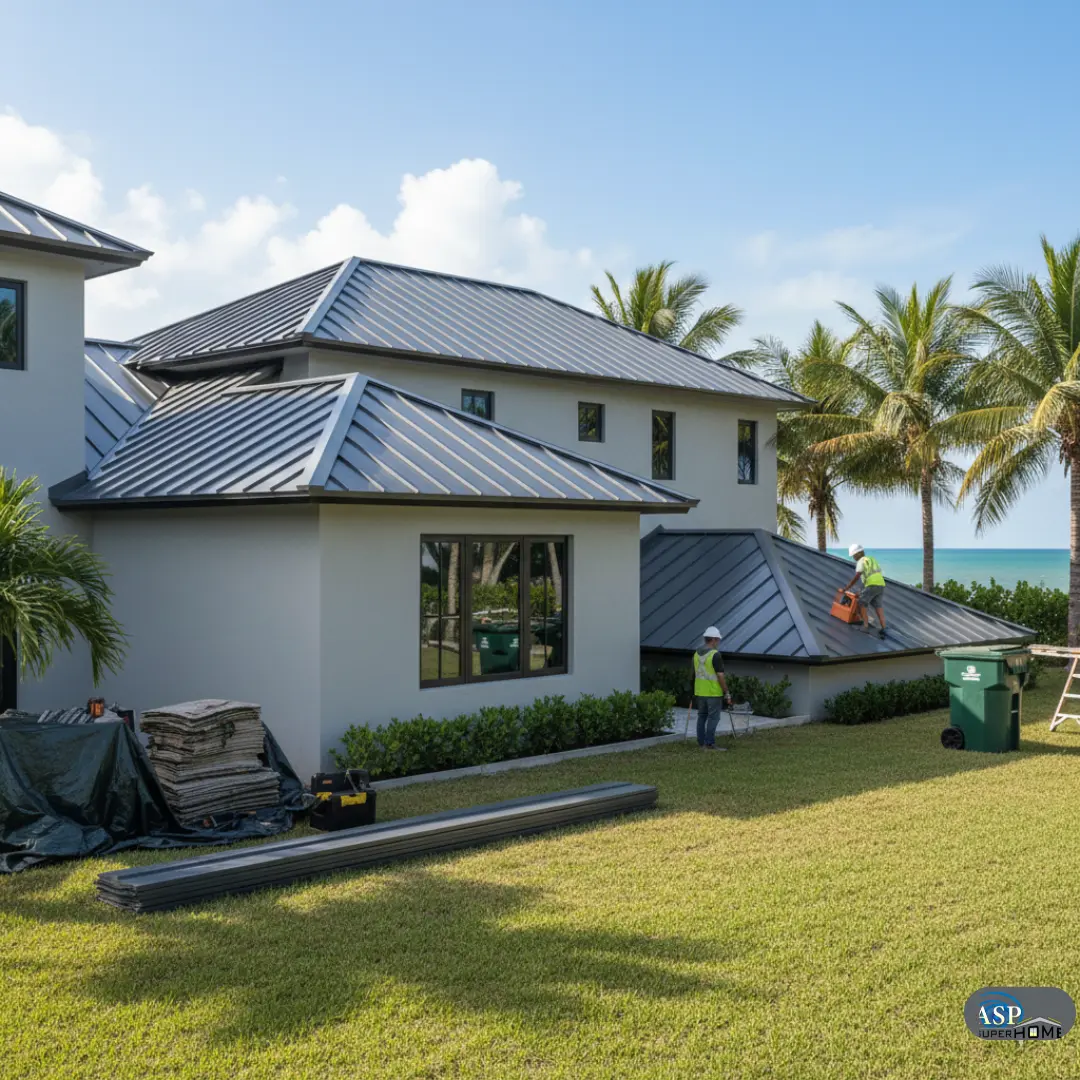
Many of the same homeowners who go solar also take the opportunity to replace an aging roof at the same time. A standing seam metal roof is one of the best surfaces for solar panel mounting, and it lasts 40 to 70 years, giving your panel array a solid platform for its entire useful life.
What Appliances Cannot Be Used With Solar Power?
Technically, there are no appliances that cannot be used with solar power. In practice, certain high-wattage, long-running appliances place the heaviest demands on any solar system, and running them exclusively on solar requires a larger and more expensive setup than a smaller one. The most challenging appliances for solar systems are those that combine high wattage with extended daily runtime: electric resistance water heaters (2,500 to 4,500W), central air conditioners (2,000 to 5,000W), electric ranges and ovens (1,500 to 3,000W), and electric clothes dryers (1,800 to 5,000W).
The real limitation is not the appliance itself but the inverter and battery capacity of the system during an outage. On a grid-tied system during normal operation, your panels supplement the grid seamlessly regardless of how large your loads are. Off-grid or during an outage, your inverter's output capacity becomes the ceiling. If your inverter is rated for 5 kW and you try to run a 3,000-watt oven, a 1,500-watt microwave, and a 500-watt refrigerator simultaneously, you exceed the inverter's capacity. Sizing your inverter and battery appropriately for the loads you want to run during an outage is a key part of designing a system with battery storage.
Appliance Wattage and Solar Panel Requirements
ApplianceTypical WattageDaily kWh (Est.)% of Home Energy UseCentral Air Conditioner2,000 – 5,000 W10 – 15 kWh~16.6%Electric Water Heater2,500 – 4,500 W4 – 5 kWh~11 – 18%Refrigerator (modern)300 – 800 W1.5 – 2 kWh~7 – 14%Electric Clothes Dryer1,800 – 5,000 W2.5 – 5 kWh/load~4 – 6%Washing Machine350 – 500 W~0.5 kWh/load~1 – 2%Dishwasher1,200 – 2,400 W1 – 2 kWh/cycle~1 – 2%Electric Oven / Range2,500 – 3,000 W2 – 3 kWh~2 – 4%Flat Screen TV (large)100 – 200 W0.4 – 0.8 kWh~3 – 4%Microwave750 – 1,100 W0.1 – 0.3 kWh~1%LED Lighting (whole home)20 – 100 W per fixture1 – 3 kWh~4 – 9%Laptop / Computer50 – 150 W0.2 – 0.5 kWh~2 – 3%Phone / Device Chargers5 – 25 W0.05 – 0.1 kWh<1%
Sources: U.S. Energy Information Administration Residential Energy Consumption Survey (RECS); Enphase Blog, "How Many Watts Do Common Home Appliances Use?" (2025); U.S. Department of Energy, "Estimating Appliance and Home Electronic Energy Use"; HowStuffWorks, "What Uses the Most Electricity in a Home?"; SolarReviews, "Appliances That Use the Most Electricity" (2025). Daily kWh estimates reflect average real-world use patterns, not continuous operation at peak wattage.
Which Appliance Is a Real Energy Drainer?
The appliance that is the most consistent real energy drainer in the home is the HVAC system. It runs continuously at high wattage for hours every day, and in warm climates like Florida, it can account for nearly half of the entire electricity bill on its own. A central air conditioner alone can use 1,450 kWh in a single month, which is more than some smaller homes use in total.
Outside of HVAC, the electric water heater is the second most significant drainer because it runs multiple times daily and draws up to 4,500 watts at a time. The refrigerator is in third place not because of its wattage, which is relatively modest, but because it never turns off. It runs 24 hours a day, 365 days a year. According to EIA data, the refrigerator accounts for 7% to 14% of a home's total electricity consumption. This is why upgrading to a modern Energy Star-certified refrigerator, which uses about 9% less energy than minimum federal standards, is one of the smartest standalone appliance upgrades you can make before sizing a solar system.
This is exactly why we recommend pairing residential solar panels with energy-reducing upgrades like impact windows. Windows with low solar heat gain coefficients (Low-E glass) can reduce the amount of heat entering your home by 70% to 80%, which directly lowers your air conditioning load. A smaller AC load means a smaller solar system needed to offset it, which improves your return on investment across both upgrades.
How Do You Calculate How Many Solar Panels You Need for Specific Appliances?
You calculate how many solar panels you need for specific appliances by first determining how many kilowatt-hours that appliance uses per day, then dividing by the daily output of one panel in your location. The formula for daily kWh is: appliance wattage multiplied by hours used per day, divided by 1,000. For example, a 2,500-watt electric water heater running for 2 hours per day uses 5 kWh daily (2,500 × 2 ÷ 1,000 = 5). A 400-watt solar panel in South Florida, with 5.5 peak sun hours and roughly 80% system efficiency, produces about 1.76 kWh per day (400 × 5.5 × 0.80 ÷ 1,000 = 1.76). Dividing 5 kWh by 1.76 kWh per panel gives you approximately 3 panels just for that water heater.
You do not actually size your system appliance by appliance. Instead, you add up your total daily or annual kWh usage for the whole home and size the system to cover that total. This is how professional solar designers approach every installation. If you want to account for future additions like an EV charger or a hot tub, build those estimated loads into your total before you finalize system size, since adding panels later often costs more per watt than getting the right size upfront. Businesses follow the same logic: a commercial solar system is sized to the facility's total energy footprint.
Does a 400W Solar Panel Produce 400W?
No, a 400W solar panel does not consistently produce 400 watts in real-world conditions. The 400W rating is determined under Standard Test Conditions in a laboratory: 1,000 watts per square meter of solar irradiance, a cell temperature of 25°C (77°F), and no wind. Real-world output depends on your actual sun hours, weather, panel angle, shading, inverter efficiency, and heat. In warm climates, panel temperatures often exceed 25°C, which actually reduces output slightly because solar cells become less efficient as they heat up. Accounting for all real-world losses, most installers use an 80% performance ratio when estimating actual output. So a 400-watt panel in South Florida with 5.5 peak sun hours produces closer to 1.76 kWh per day on average, not the theoretical maximum of 2.2 kWh.
What Is the 33% Rule in Solar Panels?
The 33% rule in solar panels is a general sizing guideline suggesting that your solar system should not be designed to exceed roughly 133% of your annual electricity consumption, to avoid generating large amounts of excess power that utilities may only credit at reduced rates. Some sources interpret it differently, as a warning not to oversize by more than one-third. In Florida specifically, net metering credit rates for excess generation are declining, dropping from 75% of retail value in 2025 to 60% in 2026 and 50% going forward. This makes accurate sizing more important than ever. Sending large surpluses to the grid at half the retail rate dramatically reduces your return on investment compared to a system that offsets 95% to 105% of your actual use.
Do Solar Panels Work on Cloudy Days?
Yes, solar panels work on cloudy days, but at reduced output. On a fully overcast day, panels typically produce 10% to 25% of their rated capacity, according to the National Solar Radiation Database (NREL) and multiple independent studies. On partly cloudy days, output drops to 50% to 80% of normal. The reason panels still work is that photovoltaic cells respond to all visible light, including diffuse light scattered by clouds, not just direct sunlight. Monocrystalline panels perform better in these conditions than polycrystalline models, because their cell structure converts indirect light more efficiently.
An interesting effect called "cloud lensing" can sometimes briefly boost output above normal on partly cloudy days. As cumulus clouds pass in front of the sun, their edges can magnify incoming sunlight, creating a short burst of higher-than-expected production. For annual production estimates, this effect and all typical weather patterns in your area are already factored into the production ratio a solar installer uses when sizing your system. A system designed for your address already accounts for every rainy and cloudy day you will have, not just the sunny ones.
Florida averages 230 to 250 days of sunshine per year, which is why it consistently ranks among the best states in the country for solar economics. Even with Florida's summer afternoon rain showers, annual solar production here easily surpasses most of the country. For homeowners who want reliable power through every outage and storm, pairing panels with a battery backup system captures daytime generation for use at night or whenever the grid goes down.
Why Is My Bill So High If I Have Solar?
Your bill is high if you have solar for one or more of these reasons: your system is undersized for your actual energy consumption, your household energy use has increased since installation, your panels are underperforming due to shading, soiling, or a failing component, or your utility applies fixed monthly charges that appear regardless of solar generation. The most common cause is an undersized system. If your solar installer sized the system based on your energy use from before you added a pool, a hot tub, an electric vehicle, or additional A/C zones, the system will not cover your full current load.
Checking your monitoring app is the first diagnostic step. Compare your system's actual daily production to what was projected at time of installation. If production matches projections but your bill is still high, the issue is increased consumption, not panel performance. If production is well below projections, you may need a solar panel inspection or repair to identify shading issues, a failed microinverter, or panel degradation. Catching underperformance early costs far less than letting it continue unnoticed for months or years.
What Runs Up Your Electric Bill the Most?
What runs up your electric bill the most is your HVAC system, specifically air conditioning. In warm states, a central air conditioner accounts for the single largest share of monthly electricity use, often representing 40% to 50% of the total bill on its own during summer. The U.S. Department of Energy confirms that products in standby mode alone account for 5% to 10% of residential energy consumption, costing the average household about $100 per year even when devices appear to be off. This is known as phantom load, and it is an easy area to reduce before sizing a solar system.
Reducing the load on your biggest consumers before sizing your solar array is the most cost-effective approach. Pairing an efficient solar system with impact windows and doors reduces solar heat gain and air infiltration, directly cutting the hours your air conditioner runs each day. Lower A/C runtime translates directly into fewer panels needed to offset your consumption, which lowers the upfront cost of your solar installation while simultaneously improving your insurance discounts.
Can a House Run 100% on Solar?
Yes, a house can run 100% on solar power, and many do. Running 100% on solar during daylight hours is straightforward with a properly sized grid-tied system. Running 100% on solar through the night and during extended cloudy periods requires sufficient battery storage to carry the home through those gaps. For a grid-tied home without batteries, "100% solar" in the annual sense means producing as much electricity over the course of a year as you consume, with the grid serving as a storage bank you draw from at night and deposit surplus into during the day through net metering. For true energy independence during outages, a battery system large enough to cover your essential loads for 24 to 48 hours is the practical path.
We install complete solar energy systems that include both the panel array and battery backup options, so homeowners can choose the level of independence that fits their goals and budget. Our team does not use subcontractors. Every system is installed and commissioned by our own certified crews, so accountability starts and ends with us.
Why Are People Getting Rid of Their Solar Panels?
People get rid of their solar panels most commonly because they are selling a home and the buyer does not want to take over a leased system, because their roof needs replacement and they did not budget for panel removal and reinstallation, or because an aging system requires repairs that exceed the perceived value. Owned panels that are in good condition are very rarely removed by choice. According to a 2025 SolarReviews study, homes with owned solar systems sold for an average of 6.9% more than comparable non-solar homes, so sellers with owned systems typically have a strong financial reason to keep them. The friction almost always involves leased or third-party-owned systems, where buyers inherit ongoing contract obligations they may not want.
Choosing to own your system outright or through a loan rather than leasing is the single biggest factor in ensuring long-term value and flexibility. For homeowners in South Florida looking at system options, our team walks through the ownership structures in detail so you can make a decision that fits your financial situation and long-term plans.
Frequently Asked Questions
Can a Refrigerator Run on a 100-Watt Solar Panel?
A 100-watt solar panel cannot reliably run a full-size refrigerator on its own. A 100-watt panel generates roughly 400 watt-hours per day under ideal conditions, while a modern refrigerator uses 1.5 to 2 kWh (1,500 to 2,000 watt-hours) per day. You would need three to four 100-watt panels, plus a battery to cover the overnight hours, to reliably power one refrigerator. Most residential installations use 400-watt panels, and the whole home's load is offset together rather than assigning individual panels to individual appliances.
How Long Will a Solar Battery Run a Refrigerator?
A solar battery will run a refrigerator for 12 to 24 hours depending on the battery's usable capacity and the refrigerator's size and efficiency. A typical lithium solar battery has a usable capacity of about 10 kWh. A modern refrigerator uses about 1.5 to 2 kWh per day, cycling on and off rather than running continuously. A 10 kWh battery could theoretically run just the refrigerator for 5 to 7 days, but in a real home scenario the battery is also powering lights, phones, fans, and other essential loads simultaneously, which reduces total runtime. Pair your battery with a solar array so it recharges each day from your panels, and your refrigerator runs indefinitely as long as you have sun.
Do Solar Panels Reduce Electricity Bills?
Yes, solar panels reduce electricity bills significantly in most cases. According to EnergySage, the average U.S. homeowner saves between $37,000 and $154,000 on electricity over 25 years by going solar. Florida homeowners specifically can expect to avoid approximately $51,000 to $53,000 in total utility costs over the life of a solar system, based on ConsumerAffairs and EnergySage data. Net metering in Florida allows excess daytime production to offset the cost of nighttime grid use. Even without zero electric bills, most solar homeowners see their monthly charges drop by 75% or more.
Why Can't You Throw Away Solar Panels?
Solar panels cannot simply be thrown in the trash because they contain materials that require careful handling at end of life, including silicon, silver, copper, and in some thin-film panels, small amounts of cadmium. The U.S. EPA has been developing rules to add solar panels to the universal waste regulations to create consistent national recycling standards. The International Renewable Energy Agency projects that cumulative solar panel waste in the United States could reach between 170,000 and 1 million tons by 2030 as older systems reach end of life. Most panel manufacturers and certified installers can help you identify proper recycling options when the time comes, typically at or near the 25 to 30-year mark.
What Is the Biggest Drawback of Solar Panels?
The biggest drawback of solar panels is the upfront cost, which ranges from $18,000 to $30,000 or more for a complete residential system before available incentives. Although prices have dropped by more than 85% since 2014 according to the Office of Solar Energy Efficiency and Renewable Energy, the initial investment still requires either a significant cash outlay or a financing commitment. The payback period for most Florida homeowners is 5 to 10 years. For those who move or sell within the payback period, a study by SolarReviews found that owned solar systems increase home resale value by an average of 6.9%, which helps recover the investment at sale even before the energy savings fully mature.
What Are Two Cons of Solar Panels?
Two cons of solar panels are the high upfront cost and the dependence on sunlight availability. The upfront cost, typically $18,000 to $35,000 for a complete residential system, is the most cited barrier. Financing options like PACE and solar loans reduce this barrier by spreading payments over time, but total cost including interest is higher than a cash purchase. The second drawback is intermittency. Panels produce no power at night and reduced power on heavily overcast days, typically 10% to 25% of rated capacity. For homeowners who want full energy independence through outages and overnight, a battery storage system is necessary, and that adds another $9,000 to $18,000 to the total investment.
Why Is It Difficult to Sell a House With Solar Panels?
It is difficult to sell a house with solar panels when the system is leased or tied to a power purchase agreement rather than owned outright. In those cases, the buyer must agree to take over the remaining contract, which some buyers are unwilling to do because of the payment obligations or uncertainty about system performance. Owned solar systems, by contrast, have the opposite effect on a sale: a 2025 SolarReviews study found that homes with owned panels sold for 6.9% more on average and spent 13.3% less time on the market. The lesson for homeowners is simple: own the system rather than lease it, and solar becomes an asset rather than a liability when it comes time to sell.
Putting It All Together
Solar panels can power every appliance in your home. The key is making sure your system is sized to match your actual total load, not just the appliances you think of first. HVAC is by far the biggest energy consumer, followed by water heating, refrigeration, and laundry. Once you know your annual kWh usage, sizing the right solar array is a straightforward calculation, and a properly designed system handles everything from phone chargers to central air conditioners without you having to think about it.
Florida's combination of 230 to 250 sunny days per year, competitive installation costs, state property and sales tax exemptions, and net metering policies make it one of the best places in the country to go solar. Adding battery backup gives you the added protection of keeping your critical loads running through the storm outages that matter most in this region.
When you are ready to find out exactly how many panels your home needs and which system design makes the most sense for your appliances and budget, reach out to ASP Super Home. We have been protecting and powering homes across the region for nearly 20 years, and every system we install is handled by our own in-house certified crews, from permit to commissioning.
Meet With a Project Manager
Your first conversation is with a Project Manager who takes the time to understand your goals, walk you through your options, and stays connected throughout your project — from the initial consultation through the final walkthrough.
.avif)
.avif)
.avif)
%201.avif)
Insights & Resources
Stay informed with expert tips on roofing materials, hurricane codes, repairs, and South Florida construction standards.


%201.avif)
%201%20(1).avif)

%201.svg)
%201%20(1)%20(1).png)
.png.png)
.png%20(1).png)
.png%20(2).png)
.avif)
.avif)


.png)
.svg)
.png)